


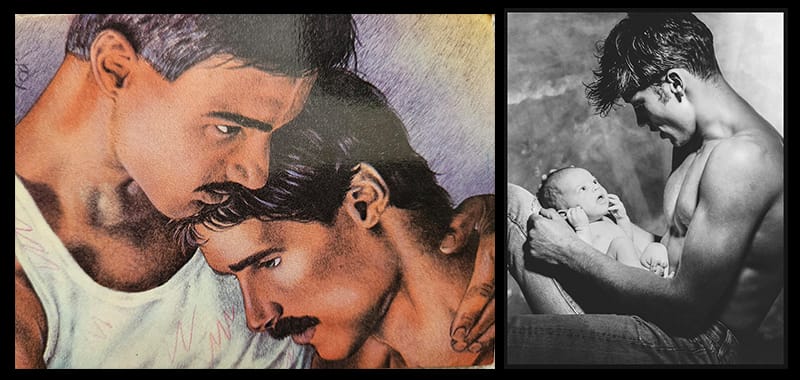
This year marks 40 years since the iconic Athena poster of a topless man in jeans holding a baby appeared on our highstreets and adorned countless bedroom walls. It became the best-selling poster in British history, with a massive cultural impact across the USA and Europe. Part of its success was down to capturing the developing concept of the ‘new man’ – masculine but sensitive. You could even trust him with a baby! It was also sexy, in a stone-washed denim, slicked back hair, totally '80s kinda way.
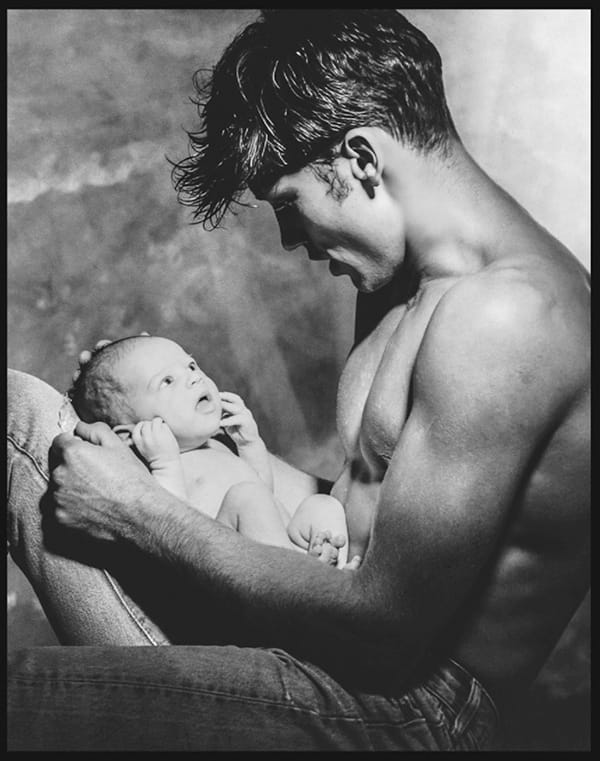
Athena art director Paul Rodriguez commissioned that image, formally entitled L’Enfant but known to everyone as Man and Baby, from photographer Spencer Rowell in 1986. It was one of many successful collaborations between the pair. A less well-known fact about the man who had the idea for the ‘man and baby’ image, is that Paul Rodriguez was gay (shocker!).
Spencer Rowell: “We met around ’82. We did mainly males, not exclusively, but I was known for shooting males. That was quite unusual. I think the assumption was that I was gay. He was an attractive man, very skinny, tall. You would know he was gay, just from his posture and his voice. He was quite camp.
“I used to have long hair, earrings, swanning about being arty. I was very interested in style, with an interesting wardrobe. I didn't wear the red handkerchief. But it shows how naive I was. I said to Paul once, your handkerchief’s falling out of your back pocket. And he looked at me in this way that Paul always did: This is important to what I’m saying to the world, Spencer!”
Spencer says he still has no idea what that meant. If that’s you as well – Google ‘gay hanky codes’.
Homoeroticism on the high street
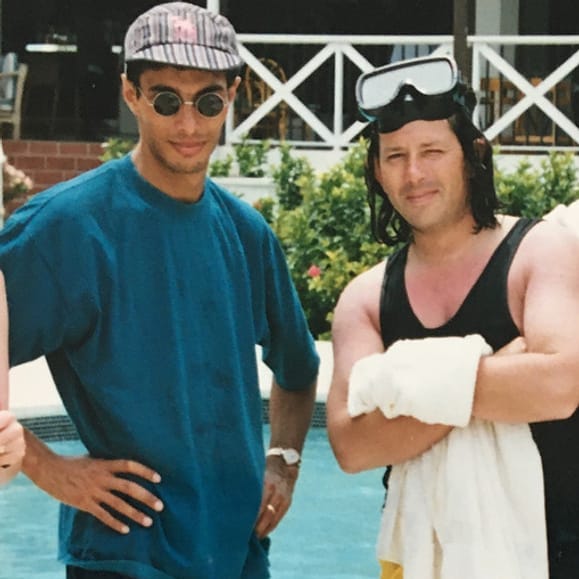
Paul Rodriguez was also an illustrator in his own right, and before the success of L’Enfant he had produced a series of air-brushed images for Athena, almost exclusively of men. These were very particular men: tanned, slim, athletic, with short dark hair and a moustache. This was the clone look. An American style adopted by many gay men in the '80s and '90s, which emphasised a masculine aesthetic, and as the name suggests it made everyone look very similar.
What was remarkable about these images is that they were for sale as posters / cards / postcards in your local Athena shop. Amidst all the other images, such as the female tennis player showing a cheeky rear cheek (produced by Athena in 1977), were these illustrations of moustached men. They were easy to overlook, but to those of a certain persuasion they were beacons of desire.
"I remember seeing these cards in the early '80s. They seemed to symbolise hope and a yearning for tenderness in a largely homophobic Britain. Beautiful images." Mike McAsey
Having images of identifiably gay men in such a mainstream setting was a revelation. Outside of specialist shops or magazines, men had not been seen in public quite like this before. In a pre-internet age, images of such men were hard to access, connecting the viewer to a world that spoke of such desires without judgement.
After the success
Spencer Rowell: “We had a great time. It was fucking heaven, fantastic to be working in that time. Then he got poorly.
“I said: 'Have you had a test?' He said: 'Well, I've made the decision that if I think about it more than 50% of the time, I'm going to go and have a test.' And we never spoke about it after that.”
Spencer recalls going to see Star Trek VI: The Undiscovered Country with Paul in the spring of 1992 at Leicester Square.
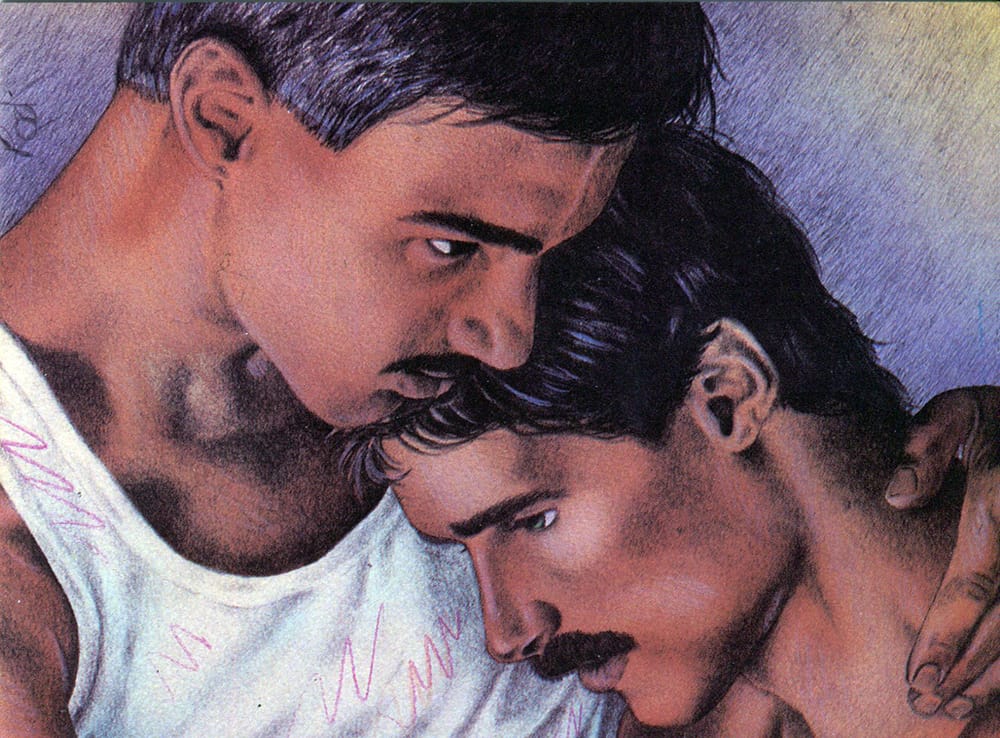
“He’d started smoking spliff. It took the edge off the distress more than anything. I had no interest in Star Trek whatsoever. He loved it. It was quite the odd couple sitting at the back of the cinema. He was sitting there stoned, really enjoying the film. Anything except think about what was actually going to happen, I guess.”
They had one final work trip together to the Turks and Caicos Islands.
“I was going off shooting the dolphins, shooting the models. Normally the art director would be on the boat standing right beside you. He wasn’t. I’d go back to the hotel room and he’d be perky enough, then I would just glance across and his dressing table was just full of pill bottles. He was in darkness.
“We came back from that trip. I was doing the retouching, the postproduction. Paul was overseeing stuff but he was tired. Anyway, it was normal not to talk for a while. I called him at his home to see how he’s doing and someone else picked the phone up. It was his boyfriend I believe. And that’s the last… he’d gone.
“When I went round there, his mum was there, I just fucking lost it. His mum was very gentle. I think she was a Buddhist.
“The Order of Service [at the funeral] was a very flash one, like a little cataloguey thing, lots of his pictures in it. He designed it. Typical Paul, all designed before his death. A lovely picture on the front cover of him in Thailand, not when he was with me, but because his dad was Thai, I think.”
Paul died from an AIDS-related illness in London on 18 December 1992, aged just 31.
Spencer Rowell and Athena Art have marked the 40-year anniversary of L’Enfant with an exhibition of images in Ramsgate, 13-31 May 2026. There is a panel dedicated to the memory of Paul Rodriguez.
Scene was founded in Brighton in 1993, at a time when news stories about Pride protests were considered radical.
Since then, Scene has remained proudly independent, building a platform for queer voices. Every subscription helps us to report on the stories that matter to LGBTQ+ people across the UK and beyond.
Your support funds our journalists and contributes to Pride Community Foundation’s grant-making and policy work.


Member discussion