



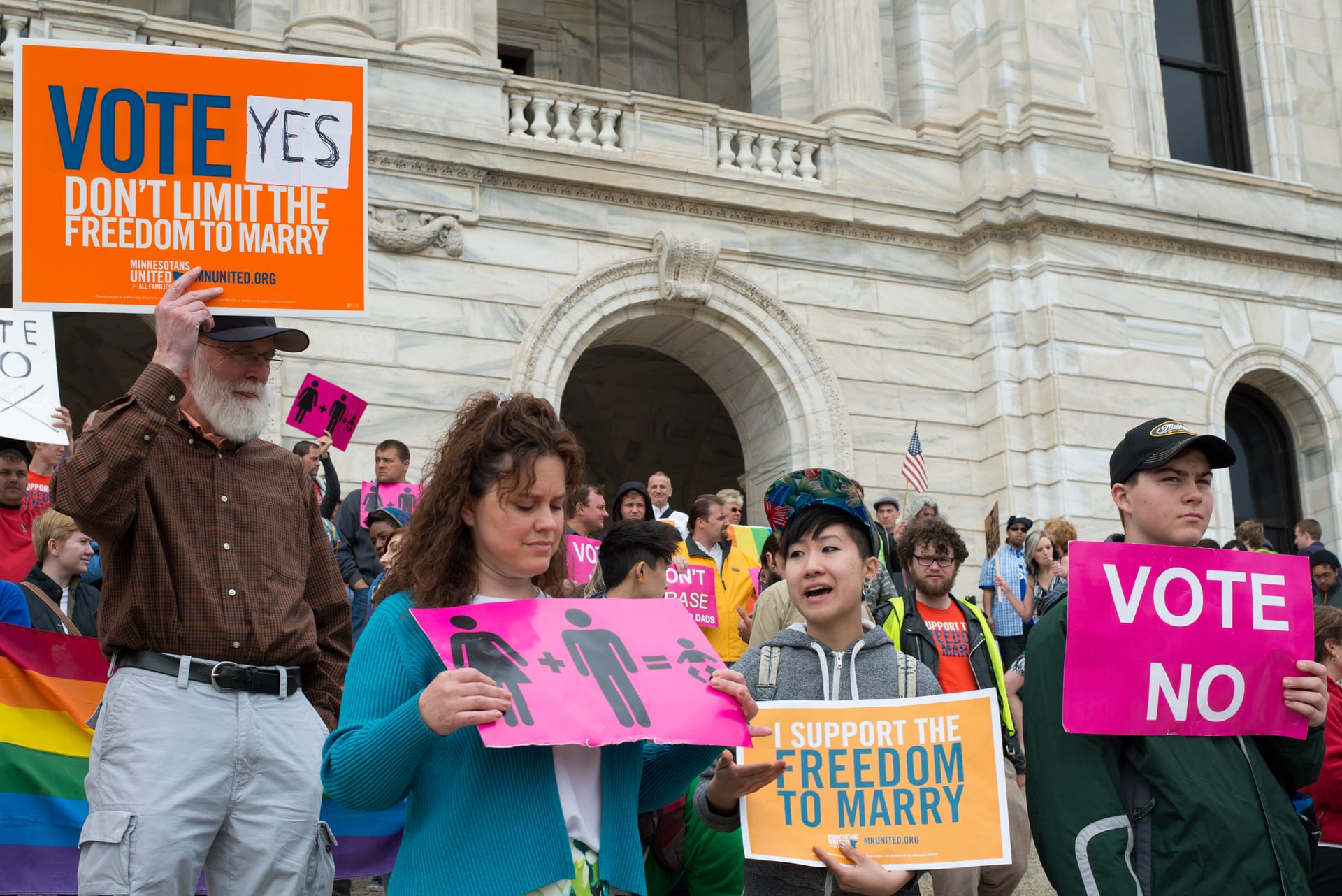
Support for same‑sex marriage in the United States has stalled after more than two decades of steady growth, with a slight decline recorded in a new Gallup poll.
The survey, conducted in May, found that 65% of US adults believe same‑sex marriage should be legal, down from 71% in both 2022 and 2023.
The shift appears to be driven largely by changing views among Republicans. Just 37% of Republican respondents said same‑sex marriage should be legally recognised, while 35% described gay and lesbian relationships as “morally acceptable”.
By contrast, opinion among Democrats and independents remains broadly unchanged, with clear majorities in both groups continuing to support marriage equality and view same‑sex relationships as morally acceptable.
The findings highlight a widening political divide on LGBTQ+ issues in the US, which is increasingly reflected in policy debates - particularly around transgender rights - and in renewed efforts in some states to restrict same‑sex marriage.
Although the drop in support is relatively small, it marks a notable shift after decades of rapid change. In 1996, only 27% of Americans supported legal same‑sex marriage. Support rose consistently over the following years, peaking at around seven in 10 adults in the early 2020s.
Attitudes towards the morality of same‑sex relationships have followed a similar trajectory. Around 40% of US adults said such relationships were morally acceptable in 2001, rising by nearly 30 percentage points over two decades.
However, Gallup’s most recent data suggests a modest reversal. The proportion of Americans who consider gay and lesbian relationships morally acceptable now stands at 62%, down from 71% in 2022.
Same‑sex marriage has been recognised nationwide since a landmark US Supreme Court ruling in 2015, which followed a series of state‑level decisions establishing legal recognition in most parts of the country.
More than 800,000 same‑sex couples were married in the US by last year, according to data from the Williams Institute at the University of California, Los Angeles.
Despite this, opposition has persisted. Last year, an appeal urging the Supreme Court to revisit its 2015 ruling was rejected without comment, though some conservative figures have continued to call for it to be overturned.
At state level, lawmakers in at least 11 states have recently introduced measures seeking to restrict or ban same‑sex marriage, although most have not progressed. In Tennessee, one proposal aimed to allow private individuals and organisations to refuse recognition of such unions, while lawmakers in Idaho passed a resolution urging the Supreme Court to reverse its earlier decision.
In parallel, several states have introduced legislation designed to safeguard marriage equality.
The new poll also indicates shifting attitudes towards transgender issues. Around four in 10 Americans now say changing one’s gender is morally acceptable, down from nearly half in 2021.
Trans rights have become a major political flashpoint in recent years, with many Republican‑led states introducing laws restricting gender‑affirming care for minors, limiting access to school facilities and barring trans athletes from certain competitions.
At federal level, similar policies have been pursued, though some have faced legal challenges. This week, a court ruled that a ban on transgender people serving in the military was unlawful.
The Gallup poll surveyed 1,001 US adults between 1 and 17 May. It has a margin of error of plus or minus four percentage points.
Scene was founded in Brighton in 1993, at a time when news stories about Pride protests were considered radical.
Since then, Scene has remained proudly independent, building a platform for queer voices. Every subscription helps us to report on the stories that matter to LGBTQ+ people across the UK and beyond.
Your support funds our journalists and contributes to Pride Community Foundation’s grant-making and policy work.





Member discussion