

Seeing Things in a Queer Light: Invisible Rainbows by Dr Alfredo Carpineti

Deeply fascinating and delightfully playful, Dr Alfredo Carpineti dazzles us with all the light we cannot see in this heartfelt ode to the universe beyond the visible. Illuminating in every sense of the word, Invisible Rainbows takes us on a breathtaking sightseeing tour of all the wavelengths of light that are invisible to the human eye, exploring the wondrous possibilities of the electromagnetic spectrum, from radio waves to gamma rays.
But light is not the only spectrum that shines at the heart of Invisible Rainbows. This book is animated by lively conversations with LGBTQ+ scientists, welcoming us into an astounding unseen universe. As Carpineti plays with the symbolic resonances of light, visibility and rainbows, ‘Invisible Rainbows’ comes to stand not only for the awe-inspiring universe beyond visible light, but also for the often-erased brilliance of LGBTQ+ scientists.
In this book, the importance of using each different wavelength of light to look at the Universe becomes inextricably linked with the importance of embracing diverse perspectives: we can only hope to understand the Universe by being open to seeing things in a different light, both literally and figuratively. It is by practising this radical openness to both human and celestial diversity that we can enrich our understanding of the Universe and one another.

Science, Carpineti reminds us, is not neutral. Science is human, subject to all the messiness, flaws and biases that humanity entails. Invisible Rainbows dismantles the illusion that science occupies an objective sphere, bringing us face to face with the myriad ways in which science is shaped by its social and political context.
Throughout, Carpineti’s reflections are skilfully inflected with a double meaning. He is talking about how we approach scientific exploration, yes, but he is also talking about how our society reacts to ‘difference’. “Reality at the smallest scale is a mess of fluctuations”, Carpineti explains. Difference, then, is the essential condition of our Universe, yet it is often feared and erased in our society.
When the Universe was mere seconds old, Carpineti tells us, everything was exactly alike … well, almost. It was the tiniest of differences within almost complete uniformity that allowed enough matter to gather for galaxies to form. In the cosmology of Invisible Rainbows, difference is the precondition of all creation: it is potential and possibility. If the smallest difference can create whole galaxies, imagine how much would be possible if we fully embraced human diversity.
This book asks us how much we could achieve if the same tenets of openness, curiosity and understanding that inform the best kinds of science also governed the way we treat one another. Astronomers can approach the stars with passionate curiosity, a desire to learn and understand, yet human beings so often fail to extend the same openness and acceptance to one another.
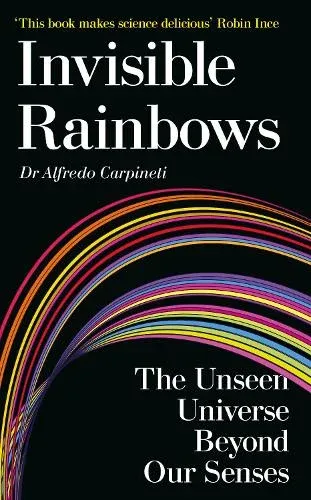
Invisible Rainbows delights in the moments where our theories break down. Carpineti sheds light on the erasure that takes place in order for scientists to arrive at a ‘perfect explanation’. For our theories to hold up, we often have to ignore certain phenomena and disregard complexities. Invisible Rainbows shows us that the places where our rules fail are rich with overlooked possibility.
The heartbeat of this book is the implicit parallel between LGBTQ+ people and the invisible light that shatters our theories. Phenomena, whether celestial or human, that flout the rules we set face erasure, yet it is precisely because they disrupt our assumptions that they hold such enormous potential to enhance our understanding of the world.
This is a book that challenges us to be open to possibility, to see beyond our senses and to think outside of the assumptions we make about the Universe and one another. In Invisible Rainbows, the horizon ceases to be an end-point and becomes instead an irresistible invitation to go beyond, to push against our limits and embrace the rich diversity of both the cosmos and humanity itself. After all, when faced with a world that “won’t give us a straight answer”, we need to harness diverse perspectives and always remain open to seeing things in a different light.
Invisible Rainbows is published by Wilton Square Books.
Scene was founded in Brighton in 1993, at a time when news stories about Pride protests were considered radical.
Since then, Scene has remained proudly independent, building a platform for queer voices. Every subscription helps us to report on the stories that matter to LGBTQ+ people across the UK and beyond.
Your support funds our journalists and contributes to Pride Community Foundation’s grant-making and policy work.





Member discussion