

REVIEW: 100 Nights of Hero is an offbeat queer love story with the quality of a children’s storybook


Words by Helny Hobbs
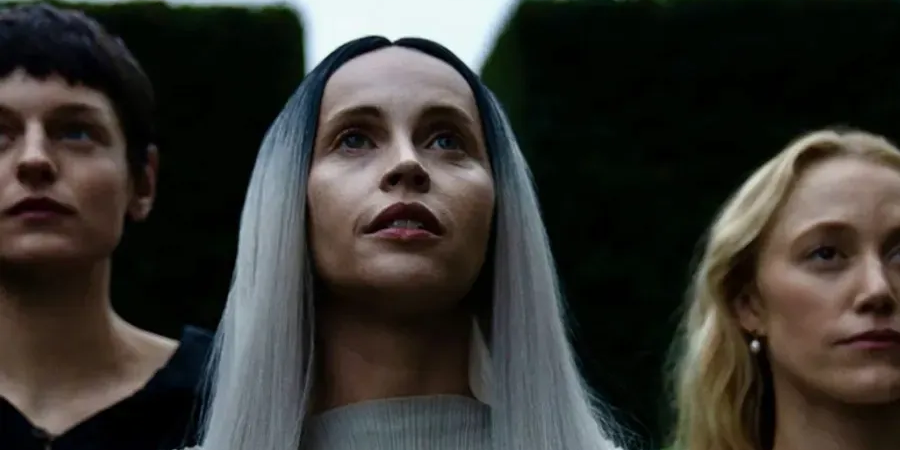
100 Nights of Hero (2025) is a visually exquisite fairytale with the dry humour of a Yorgos Lanthimos film, and the dollhouse-esque aesthetic of a Wes Anderson. The film is Julia Jackman’s interpretation of the award winning graphic novel by Isabel Greenberg, which is in-turn based on the Middle Eastern folk tale One Thousand and One Nights: a compilation of the stories told by Scheherazade as she tricks King Shahryār into loosing track of how many nights they have spent together.
My dad used to read One Thousand and One Nights to me when I was young, and from the moment I heard about 100 Nights of Hero I was beyond excited. With such a limited cinema release in the UK I grabbed a ticket to the one screening I could make, only to have my bike tyre come off on the way. I made it nonetheless! Since, my feelings towards the film have crystallised. To me, the highlights of the film are its great casting and visually stunning world building, however it could have been bolder in its interpretation of the love story between Cherry and Hero found in the graphic novel.
100 Nights of Hero is set in the Empire of Migdal Bavel, where three moons hang in the sky, and the patriarchal order of the Beaked Brotherhood enforces devotion to the deity Bird Man (Richard E. Grant). Women are not allowed to read or write and are property of their husbands.
In this world we find Cherry (Maika Monroe), a newlywed who is despairing over her husband Jerome’s (Amir El-Masry) lack of interest in her, and the fact that the Beaked Brothers have given her 100 days to fall pregnant, blaming her for her lack of pregnancy. There is suggestion that Jerome is in fact gay, and that this is the reason for the lack of consummation of their marriage. One day Jerome’s friend Manfred (Nicholas Galitzine) comes to stay and he makes a bet with Jerome that he can seduce Cherry. Jerome gives him 100 nights to do so, and goes away on his travels.
Cherry has a maid, Hero (Emma Corrin), the child of a storyteller in a distant land who sent Hero away so they would avoid the fate of becoming a man’s property. Hero is sharp, worldly, and has a quick tongue. They sense the danger and the intentions of Manfred, and devise a plan to stall him by telling stories which make him loose perception of time. Through these stories, Hero tells of brave women such as Rosa (Charli XCX) who have defied the Beaked Brothers and carved out their own autonomous lives. These speak to Cherry who slowly begins to question her life, and the nature of her feelings towards Hero.
After catching Hero in the forbidden act of writing, Cherry has a bout of fear and resolves to sleep with Manfred and get herself pregnant in order to avoid execution by the Beaked Brothers. However this is the 100th night, and Jerome arrives home to find them in bed together. Manfred tosses Cherry aside, while Hero tries to save Cherry by claiming they bewitched her. Cherry admits she loves Hero and resolves to be taken by the Beaked Brothers. The pair refuse to admit wrongdoing and are executed, but are saved by Hero’s grandmother ‘the Moon’ (Felicity Jones) and become twin stars in the sky. The tale of their defiance spreads throughout the kingdom and causes a great revolution.
A lot of reviews find the film to be ‘style over substance’ with ‘flimsy’ storytelling that lacks depth. However this felt like a stylistic choice to me (albeit one that may alienate some viewers). The on-the-nose narrative is what makes the film feel like being read a story as a child, curled up in bed.
One of the main themes of the tale, in a way that is very meta, is the power of storytelling. The film explores how stories can be used as weapons to both confine and liberate people. In Jerome’s castle, stained glass windows impart stories of women who have been executed for transgressions: Janet the Barren, Sara the Unfaithful, Nadia the Lesbian… These stories are the moral education of the women of Migdal Bavel. However Hero (a member of the League of Secret Storytellers) retells these women to be brave and bold protagonists - martyrs inspiring alternate ways of living within the oppressive Empire.
These stories open Cherry’s eyes, whilst simultaneously deepening the bond between her and Hero. Jackman remarks that “stories are the way we connect with each other, but also can enlighten us. They can make us realise our experiences are more common than we thought”. She has spoken about how she learn this in her childhood, when she used to sit in her Ukrainian grandmother’s shed while groups of women would hang out, make quilts, and tell stories.
Paralleling Hero, Jackman, in bringing 100 Nights of Hero to our screens, reshapes how we know fairytales as instead of a prince and a princess we find a queer love story at the heart of this film.
In the graphic novel, Hero and Cherry are in a relationship from the outset and I found the decision to change this to be an interesting one. The film becomes about lesbian pining, with Hero and Manfred competing for Cherry’s adoration, as well as repressed sexuality, as Cherry slowly realises the nature of her feelings for Hero. These are both very relatable queer themes, however sticking to the plot of the novel would have made for a more radical film.
Maika Monroe’s performance was perfect for the offbeat style of the film, however her chemistry with Hero felt flat and lacking. The moment when she broke free from her mental shackles and tells Hero she loves her felt lacking in crescendo, and I missed some internal conflict in her before this moment. This contrasted Emma Corrin’s deeply impactful performance as a pining and protective Hero, which was complimented by the performance of Nicolas Galitzine who was a perfect casting for Manfred.
The strongest aspect of the film for me is the stunning visuals, which bring Isabel Greenberg’s illustrated world into glorious technicolour. Hats off to Sofia Sacomani for the production design. Each frame of the film is straight off a Pinterest board, consisting of medieval scenery adorned with sunset lamp lighting, starry candles and celestial skies.
This is backdrop for Susie Coulthard’s thoughtful costuming. Manfred’s loose, low cut shirts contrast the stiff, constrictive attire of Hero and Cherry. The outfits have medieval and nunlike influences that enhance the themes of ceremony and organised religion, elevated with items designers such as Cecilie Bahnsen and Elie Saab. The Beaked Brothers don comically ridiculous face pieces, which are reminiscent of the flavour of parody you find in Gulliver’s Travels.
Tying everything together is a incredible soundtrack. Oliver Coates (the composer behind the soundtracks of Phantom Thread, Aftersun and Pillion) blends classical and experimental electronic styles to create a soundscape that feels new, while complimenting the medieval and ceremonial aesthetics of the film. It does a great job of creating an atmosphere of magic and unease, and of making you feel Manfred’s discombobulation with the passing of time.
Overall, 100 Nights of Hero did not disappoint. Despite some unfavourable reviews, it seems destined for cult status amongst queer viewers who will value the innovative lesbian storyline. Its aesthetic achievements are to be commended. Ultimately, I feel the film is like a children’s storybook: it has few layers, but a vibrant surface that makes you feel warm and satisfied.
Scene was founded in Brighton in 1993, at a time when news stories about Pride protests were considered radical.
Since then, Scene has remained proudly independent, building a platform for queer voices. Every subscription helps us to report on the stories that matter to LGBTQ+ people across the UK and beyond.
Your support funds our journalists and contributes to Pride Community Foundation’s grant-making and policy work.




Member discussion