

INTERVIEW: Egyptologist Curtis Ryan Woodside on Pride, Pharaohs, Céline Dion and Ancient Egypt's queer history
"We do know of gay relationships in Ancient Egypt but it's not written about so much. Not because it was taboo but because it was not an issue."


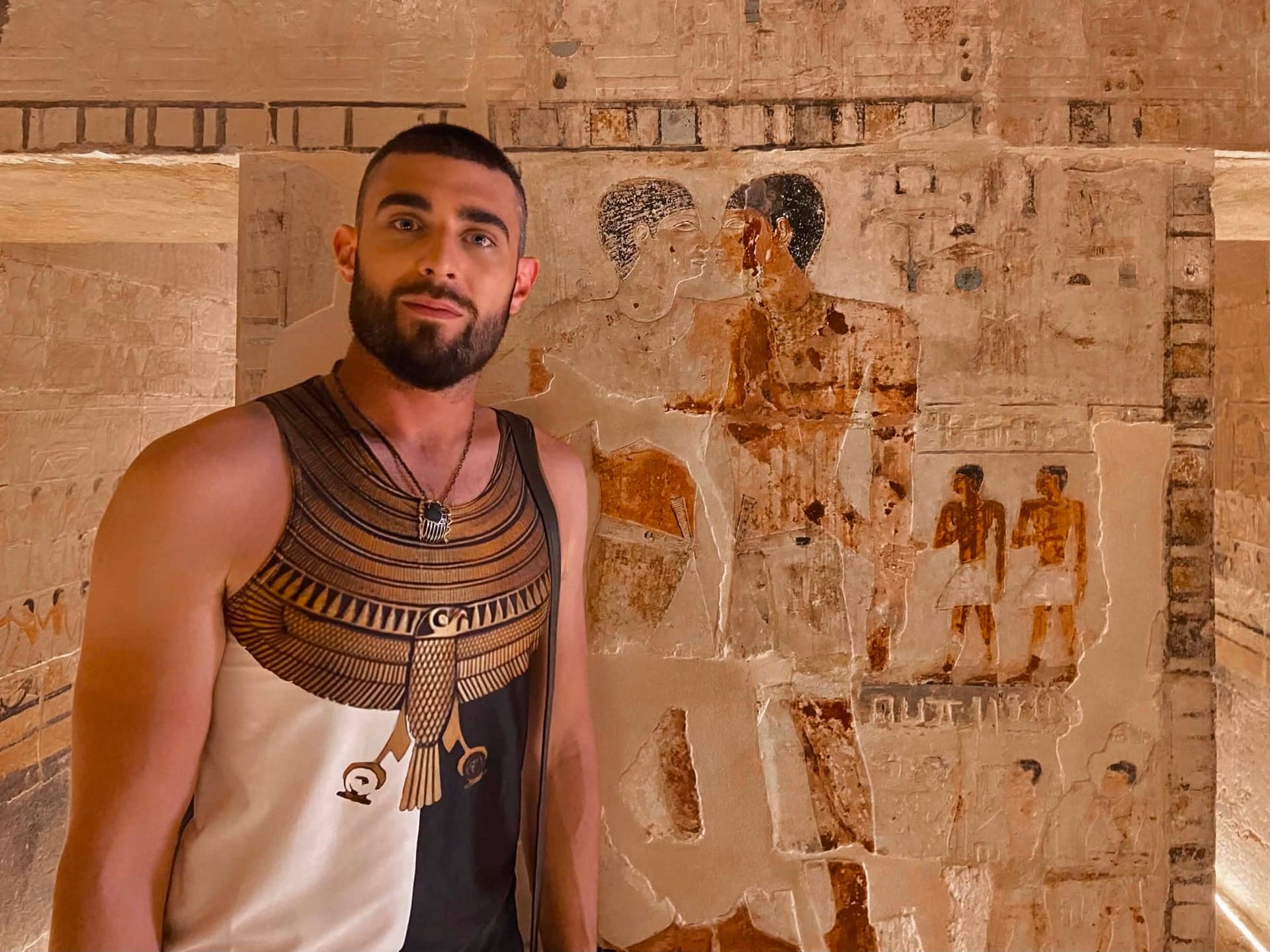
Curtis Ryan Woodside is basically proof that having one career path is overrated. The openly gay South African filmmaker, author and Egyptologist has built a massive global following (including me) by making history feel anything but dusty. Through captivating documentaries and collaborations with iconic experts like Dr Zahi Hawass, Salim Ikram and Sofia Aziz he's turned the ancient world into something genuinely exciting, relatable and binge worthy.
Now living in Florence (in Italy) with his husband Filippo Adami, Curtis got started ridiculously early. At just 15 he was already producing a documentary about Céline Dion and by 2012 he'd directed the short film Fear of Hue narrated by none other than Daniel Radcliffe. Yep that Daniel Radcliffe, Harry Potter himself!
In 2017 Curtis turned a lifelong obsession with Ancient Egypt into a career in Egyptology and instead of choosing between filmmaking and history he did what all the coolest people do and combined both. Today he writes, directs and produces feature-length documentaries that blend meticulous research with cinematic storytelling, transforming events from thousands of years ago into stories that feel fresh, immersive and totally gripping.
More than 24 million YouTube views, streaming success on platforms including Amazon Prime and Apple TV, multiple award wins and official selections at 69 international film festivals. Not bad for someone who turned a childhood passion into a global audience.
As an openly gay filmmaker and Egyptologist, Curtis is challenging stereotypes and proving that queer representation belongs in every corner of society including places people don't always expect....like ancient tombs and archaeological excavations. Oh Curis is an author too by the way and has a new book coming out this winter.
Our conversation takes a whirlwind trip through ancient queer history, mummy mysteries, mythology, Henry Cavill, Pride, homophobia and a completely necessary detour into the greatness of Céline Dion. We also talk about the surreal experience of walking through monuments that have stood for thousands of years and the emotions that come with bringing their stories back to life. From the sands of Giza to the hidden LGBTQ+ stories of the ancient world, pour yourself a heneket and let's dive in....head first!
DALEYPOP: CURTIS! For our readers who might not know you yet, can you tell us a little bit about yourself and what you do?
CURTIS RYAN WOODSIDE: I don't expect many to know who I am unless they're interested in history. My first direction in life was to be a film maker although I have always been interested in Ancient Egypt since I was a child. I first visited Egypt in 2017 where I shot a primarily travel based documentary. But seeing the place I'd always wanted to visit made me focus even more on Egyptology and lead me to combine my two passions.
DALEYPOP: That's such a clever way to combine two completely different passions! You grew up in South Africa where history wasn't even offered as a school subject, right? Yet you've gone on to become one of the world's best known Egyptologists....do you remember exactly how and when you first became fascinated by Ancient Egypt and what was it about the subject that captured your imagination so completely?

CURTIS RYAN WOODSIDE: That's right, when I was at school in South Africa history was not a subject one could take for a while then toward the end of high school the government brought it back! I never took history in the last few years at school though. I had always been reading Egyptology books since I was around 6 years old and even more so, watching documentaries! But the inspiration hit me whilst on a bus at 6 years old going from South Africa to Zimbabwe to visit my grandmother. They were showing The Mummy (1999 Version) and I was hooked. Not just because of the gorgeous Brendan Fraiser and Rachel Weisz....but the beauty of the art of Ancient Egypt. Something about it just stirred something in me. We arrived before the film had ended. I was furious and made it my mission to see the end of this film. Now I've seen the end hundreds of times.
DALEYPOP: For years people have debated how the pyramids was built, but in 2013 along came the Diary of Merer, a 4,500 year old papyrus written by someone who actually worked on the project! So cool! Can you tell us more about how significant that discovery is and what does it reveal about life on one of history's greatest construction sites?
CURTIS RYAN WOODSIDE: Such a fantastic discovery. It really tells us where the stones came from and how they were brought to Giza. Merer even tells us that he was delayed in a queue for a whole day waiting at the Giza port while other barges arrived with stones. I actually just finished a doc with Dr Zahi Hawass as executive producer about Khufu. In this we will reveal new discoveries about how the pyramids were built and how this diary has revealed a new length of reign for Khufu.
DALEYPOP: The pyramids are still standing but most of the tools used to build them have disappeared. Is that one of Egyptology's greatest mysteries or do you think there's actually a fairly simple explanation?
CURTIS RYAN WOODSIDE: Giza is in the delta region, its not as dry, thus it can't preserve things as well as other sites. A lot of the wooden sledges would have been recycled into other things and others would decay, the same of any metal objects used. Wood was rare for them, so they would have reused. We have a few of these items from tombs at Giza.
DALEYPOP: Hieroglyphs are often portrayed as a mysterious code in films and popular culture but what's the most fascinating thing people don't know about them? Is there a particular inscription or symbol you've always been especially obsessed with?
CURTIS RYAN WOODSIDE: Hieroglyphs are incredible, there are over 1000 hieroglyphs. There are glyphs we dont even know the meaning of yet. But it a very clever form of writing. Its like an alphabet yet some words can be written with 3 glyphs and also reduced to just one at the same time. I don't think I have one favourite but if I had to choose, then maybe the birds. There's a chick/quail which makes the "u" sounds, or the owl for "m" or the falcon for "hor".
DALEYPOP: I'm not sure if you've seen but you can stay overnight now at the Natural History Museum in London which I personally think is SO COOL so if you could spend a night in any Ancient Egyptian tomb, temple, or necropolis what would you be most excited to see?
CURTIS RYAN WOODSIDE: I've been so fortunate to have been to some very remote places in Egypt that no tourists goes to and to have these tombs and temples all to myself. This April we went to some tombs in middle Egypt where the doorway had been naturally covered up by sand.
We had to dig the sand out of the way and even stumbled upon some mummy wrappings.
I think the Temple of Seti in Abydos would be amazing to see alone at night. There's so many details there.
DALEYPOP: I'm fascinated by mummification, particularly animal mummies so one of my favourite documentaries of yours (with Salim Ikram) naturally is the one from 2023 about cat worship but what's the most unusual or lesser known animal mummy you've encountered during your career and what can these animals tell us about how the Ancient Egyptians viewed nature, the gods and the way people understood the world around them?
CURTIS RYAN WOODSIDE: There are shrew mummies, absolutely tiny! But most of the animal mummies are actually fake. Most only contained one bone of even a feather (just the essence). I've seen mummified hedgehogs. We know there was a hedgehog goddess Abaset who was only shown once in Bahariya. No one knows her function but I think a hedgehog rolling up into a ball, this could protect people in the oasis from the harsh weather such as sand storms. I've also handled an ibis mummy which was drenched in resins and was very weighty, clearly that priest was showing his overflowing devotion. A few years ago I went to the animal mummy catacombs and just at the entrance there still stood the animal mummification room. It smelled vile so think twice about animal mummies!
DALEYPOP: Which piece of funerary art or tomb decoration do you think deserves to be every bit as famous as Tutankhamun's mask?
CURTIS RYAN WOODSIDE: Oh gosh! There's two death mask that people should pay more attention to. The 13th dynasty Pharaoh Hor Awibra. His mask was found at the black pyramid and has gold, copper and faience on it. Then there is Psusennes. His gold mask is exquisite and was totally overlooked being discovered after Tut. I have a theory that this mask is rather for Ramses II being recycled by priests in the intermediate period but that is explained in great detail in my The Great Life Of Ramses doc.
Something that readers may find interesting are the scenes of male gods kissing/embracing the pharaoh, this would seems slightly queer coded but it also represents the gods breathing life into the king. In Kharga theres a scene of a living pharaoh kissing/embracing a deceased pharaoh (both are the same man) where the pharaoh is making sure his place in the afterlife is secured.
Of course there is lots of semen related art in Egypt, particularly the god Amun-Min who can be seen ejactulating often.
The god of the Earth Geb is also often shown with his legs tossed over his head with his own penis to his mouth while ejaculating into his mouth. This symbolises the role of self regeneration. He is fertilising the earth, which is himself.
DALEYPOP: Oh wow, I'm flustered now. Sorry to change the subject back to Tutankhamun but I still can't get over that one of Tut's knives that was found in his tomb with him was made from a meteorite so does that mean the Ancient Egyptians were literally working with material from outer space?! Wild. Is that one of the coolest discoveries in Egyptology or do you think there's an even wilder Ancient Egypt fact that deserves more attention?
CURTIS RYAN WOODSIDE: Oh that's for sure the most fascinating. But I think it's more interesting that the objects from Amarna were found in Viking graves. To me this is more exciting to know that the trade routs were so extensive.
DALEYPOP: Do we know how the Egyptians viewed these mysterious pieces of rock that fell from the sky?
CURTIS RYAN WOODSIDE: For them this would be a gift from the gods and thus would be sacred. Because it would have appeared as a giant fireball coming to earth, it's linked to the sun god Ra as well as the scarab Kheper.
DALEYPOP: Ancient Egyptians invested extraordinary effort into preparing for the afterlife. What can their attitudes towards death teach us about how we live our lives today?
CURTIS RYAN WOODSIDE: They didn't celebrate death, in fact they wanted to enjoy this time as much as they could and so they wished to make the next life as easy and comfortable as possible. That's why they prepared. So let's just live life!
DALEYPOP: One of the most discussed relationships in Ancient Egyptian history is that of Khnumhotep and Niankhkhnum who are often described as the first recorded same sex couple in history....what's your take on their story though and do you think modern audiences sometimes project contemporary ideas about sexuality onto the ancient world?
CURTIS RYAN WOODSIDE: I always try to look at history with a neutral view. I think it's dangerous to put our modern views on the ancient world. Same as we wouldn't relate with the Victorians today. I've visited this the tomb of Khnumhotep and Niankhkhnum at Saqqara. As you enter you are actually met with them with their wives and children, then there's the famous scene where they are holding hands and kissing/embracing. Like I said this is symbolic for giving life. Yes they were beauticians which some people might think is bit of a gay job but they had wives and children. They weren't brothers either as some say. Different sets of parents. If I look at it from a human perspective, those lucky enough have experienced the joy of having a best friend that we want to do everything with (platonically). Tombs were expensive. I think these are two men who were best friends who then pooled their money and created a joint tomb and this famous image is showing this bond of each giving the other life in the afterlife. We are currently working on a doc about many of the mysteries at Saqqara so watch this space!
DALEYPOP: The story of Horus and Seth has been interpreted as everything from political allegory to a discussion of masculinity, sexuality, power and consent. Why do you think this myth continues to spark such passionate debate today too and can you tell our readers about Horus and Seth if they don't know who I'm talking about?
CURTIS RYAN WOODSIDE: Seth and Osiris were brothers, Seth killed Osiris out of jealousy. Osiris' son then sought revenge against Seth. During their long ages of battle, Seth tries sometimes to seduce Horus and at some points Horus is "topped" by Seth....Seth saying lines like "you have perfect thighs, your buttocks is soft and round", we know then that Seth says he ejaculated in Horus. Isis then summons forth this semen from Horus but he produced none of it, rather saying that he caught it in his hand and threw it in the Nile.
Horus masturbates into a jar and pours it over Seth's favourite food (lettuce) which Seth then eats.
This is always seen as a battle of good vs bad. It shows how being the dominant one in a homosexual relationship means you are winning. But is that always so? This is all very homoerotic before it was a thing. We do know of gay relationships in Ancient Egypt but it's not written about so much. Not because it was taboo but because it was not an issue.
DALEYPOP: Do you think historians are getting better at recognising and discussing possible queer stories from antiquity or is there still some reluctance within the field?
CURTIS RYAN WOODSIDE: A lot of younger historians are telling these stories more. Older generations had different views, especially the Victorians. Sex was a taboo, gay or straight. There's even a statue of Amun-Min where they removed his penis and added an exist arrow sign over it in The British Museum.
We have examples of homosexual relationships all the way from the Old Kingdom, we can even seen some scenes of two women playing a harp with the glyphs saying "I love you".
Pharaoh Pepi II Neferkare is even known from texts saying he would visit the house of his general every night and spend many hours to quote "doing what he desired with him". We have a marriage statue from Ramses II reign of two women and from Akhenaten's reign we have another marriage statue of two men who have adopted a child. And let's not forget Akhenaten's co-regent Smenkhkare who is shown in some very loving images together.
DALEYPOP: Ancient Egypt's relationship with Greece is something I find fascinating. Please correct me if I'm wrong, but I'm sure we know there were diplomatic exchanges, gifts and tributes flowing between the two cultures and one famous example is Pharaoh Amasis II contributing to the rebuilding of the Temple of Delphi after it was destroyed by fire. What do you think these exchanges tell us about the relationship between Egypt and the Greek world? Were such gifts political statements, religious acts of devotion or maybe both?
CURTIS RYAN WOODSIDE: Well the Greeks say that all the gods are the same, they just have different names because of different languages. The Egyptians were allies with the Hellens for Millenia. From Thothoses III we see Greeks bringing gifts and even under Ramses II we know Greeks helped in the battle of Kadesh from Greek armour found in Crete with Ramses name stamped on. It is interesting that Greece and Egypt were never enemies. Unless you count a short civil war under the Egyptian priest Wennefer vs Ptolemy the 5th.
DALEYPOP: You've been fortunate enough to visit places that most Egypt enthusiasts like myself can only dream about including the legendary Tomb of Nefertari. How many times have you been inside and what's it like walking into one of the most beautiful tombs ever discovered? Does the magic ever wear off or do you still find yourself staring at the walls in complete disbelief? I feel like I'd be emotional.
@curtisryanwoodside Streaming now: NEFERTARI THE GREAT QUEEN OF ANCIENT EGYPT! Join Curtis Ryan Woodside, Dr Zahi Hawass, Sofia Aziz & Dr Salima Ikram as we discover new evidence in the life and death of the great royal with of Pharaoh Ramses the second! Streaming now on YouTube & It will soon be available on many other streaming platforms. #documentary #egypt #historyfacts #ancientegypt #nefertari ♬ original sound - Curtis Ryan Woodside
CURTIS RYAN WOODSIDE: I've been so lucky to see her tombs 6 times now. Nefertari is my favourite Egyptian queen. Her tomb is so beautiful and peaceful. Every time I go in I'm filled with emotion, I cry each time! I don't know why. We worked hard a few years ago to have the tomb closed after Andy Plaksin showed me some images and the deterioration was very noticeable. I sent them to the ministry and we closed the tomb. Something so beautiful needs to be preserved and if that means we can't go in well then so be it.
DALEYPOP: I know you're a huuuge fellow Céline Dion fan so I need to ask a silly but also....kinda serious question. If Celine were invited to perform at the opening of a newly discovered Egyptian tomb....which song of hers do you think would be the perfect choice and why?
CURTIS RYAN WOODSIDE: You joke, but the ministry asked me in the past to help them organise a concert in Egypt with Céline performing inside the Luxor Temple. They sent the concept and Céline declined saying that it's a sacred space and she would not want to damage anything by doing a concert in the temple. I've known Céline since I was 11 years old. She's one of the most thoughtful people out there so I know what she said she really means.
DALEYPOP: Wait YOU KNOW CÉLINE DION?! Omg....which Egyptian god or goddess do you think would be most likely to have an obsession with Céline Dion like we do?!
CURTIS RYAN WOODSIDE: Oh the goddess Mout or Hathor. Hathor maybe more. She was the goddess of singing who had so many singers in her temples. And the goddess Mout was the mother goddess and she would relate to Céline.
DALEYPOP: What do you think of Dansons and Bonjour, Pardon, Merci by the way and did you get tickets for her comeback shows in Paris?!
CURTIS RYAN WOODSIDE: Her new songs are great, she's finding her new voice. She's a fighter. I've seen Céline live 15 times live but I'm conflicted about the new shows. I hope she's not under a contract or feeling pressured by fans to get back on stage. I didn't get tickets because if something happens at the shows, I didn't want to feel like I had a hand in that.
Céline is strong, but stiff person syndrome is not something to take lightly and I hope she wouldn't do anything she didn't want to do. So we are all hoping for the best for these shows but if Céline wanted to stay home and enjoy life, I'd accept that too. Basically we all just want the best for her and don't want her to be pressured into a contracted show....like what happened to Michael Jackson.
DALEYPOP: South Africa became the first country in the world to explicitly prohibit discrimination based on sexual orientation in its constitution while Italy has followed a different path on LGBTQ+ rights. Having called both countries home, how do you view the progress that's been made and what challenges do you think still need to be addressed?
CURTIS RYAN WOODSIDE: South Africa is quite open minded but there are homophobic people all around the world. I think the sooner everyone realises that who someone else is in a relationship with doesn't effect them at all, the same was what my postman is watching on TV doesn't effect me. Be concerned with your own life and let others do what the do, it really doesn't concern you unless they are physically harming someone, leave it.
I really hate politics, but I also hate people being discriminated against.
DALEYPOP: Same! What does Pride personally mean to you?
CURTIS RYAN WOODSIDE: I've never been to a Pride event before. It's mostly fear, there are crazy people out there and we are still in a world where we need to be fearful that something bad could happen. Any gay person will understand that feeling.
For me pride really is more about being happy and accepting of yourself.
Unfortunately we still have to watch over our shoulders most of the time but being proud of who you are and being cautious of the world who still don't understand you can go hand in hand for now. You know what I mean? Straight people don't understand it but the bad looks, the whispered comments, we see it all. We don't walk around and give straight people bad looks. In March I was attacked by a homophobic neighbour right outside my front door, they called me the f slur. To be attacked just because someone else doesn't agree with who you have sex with in private is nonsensical. Mind your own business.
DALEYPOP: I feel like I need to ask for our LGBTQ+ readers who dream of standing in front of the pyramids one day, what's your advice? Asking for me too. What's been your experience of visiting and working in Egypt as a gay man and are there any common misconceptions queer travellers have about the country?
CURTIS RYAN WOODSIDE: Egypt is a country that very much relies on tourism, the people are also very welcoming of all. As long as you go there and are respectful. Don't walk around with rainbow flags or unicorn backpacks, don't hold hands or anything like that in public (most people don't do that anyway in other countries anyway) and please just don't use Grindr there. If you go with the mindset of just being there for the ancient sites, that's perfect.
DALEYPOP: Time for a super deep question. Who's your crush of the day? It can be an Ancient Egyptian, Hollywood star, '90s heartthrob or your husband....all answers are valid!
CURTIS RYAN WOODSIDE: It has to be my husband Filippo everyday! But also Henry Cavill, did you see that Ascot video!?
@italianwatchspot Henry Cavill debuts at Royal Ascot with a ultra rare Longines from 1926 #longines #royalascot #henrycavill #watch ♬ suara asli - Rae
DALEYPOP: Of course I did! If you could ask any Ancient Egyptian one question, who would you choose and what would you ask them?
CURTIS RYAN WOODSIDE: What a difficult question! Maybe ask Ramses II what really happened at Kadesh? Or ask Nefertari if she was jealous of Ramses other wives? Or Maybe see what Pepi II was really getting up to on those late night visits!
DALEYPOP: Do you have any plans to visit Egypt again soon and how often do you typically make the trip each year?
CURTIS RYAN WOODSIDE: I try to visit at least once a year. But when I do go it's for a long time, usually over a month, the longest was 3 months. I might be heading there again in September to film something with Dr Hawass in Saqqara but it all depends on what's discovered.
DALEYPOP: I could literally talk to you all day but last question. You've already built an impressive body of work as an Egyptologist, filmmaker an author. What's next for you? Are there any documentaries, books or creative projects in the pipeline that you're excited for and where can our readers follow you?
CURTIS RYAN WOODSIDE: I currently have 4 documentaries waiting to be published. I'm sure the one about Khufu where Dr Hawass shows us new discoveries about the great pyramid for the first time will be of great interest to people but I do have a list of over 50 documentaries that I want to make. Most of them have already been filmed but just need to be written and edited now. I also have a new book I'm working on called Ancient Egypt Up-Close which is going to be 380 pages of amazing photographs of details of scenes and objects. That should be coming in November/December but I do still dream in the future of making an animated film about Pharaoh/Queen Sobekneferu, the first ever confirmed female Pharaoh.
Scene was founded in Brighton in 1993, at a time when news stories about Pride protests were considered radical.
Since then, Scene has remained proudly independent, building a platform for queer voices. Every subscription helps us to report on the stories that matter to LGBTQ+ people across the UK and beyond.
Your support funds our journalists and contributes to Pride Community Foundation’s grant-making and policy work.




Member discussion