



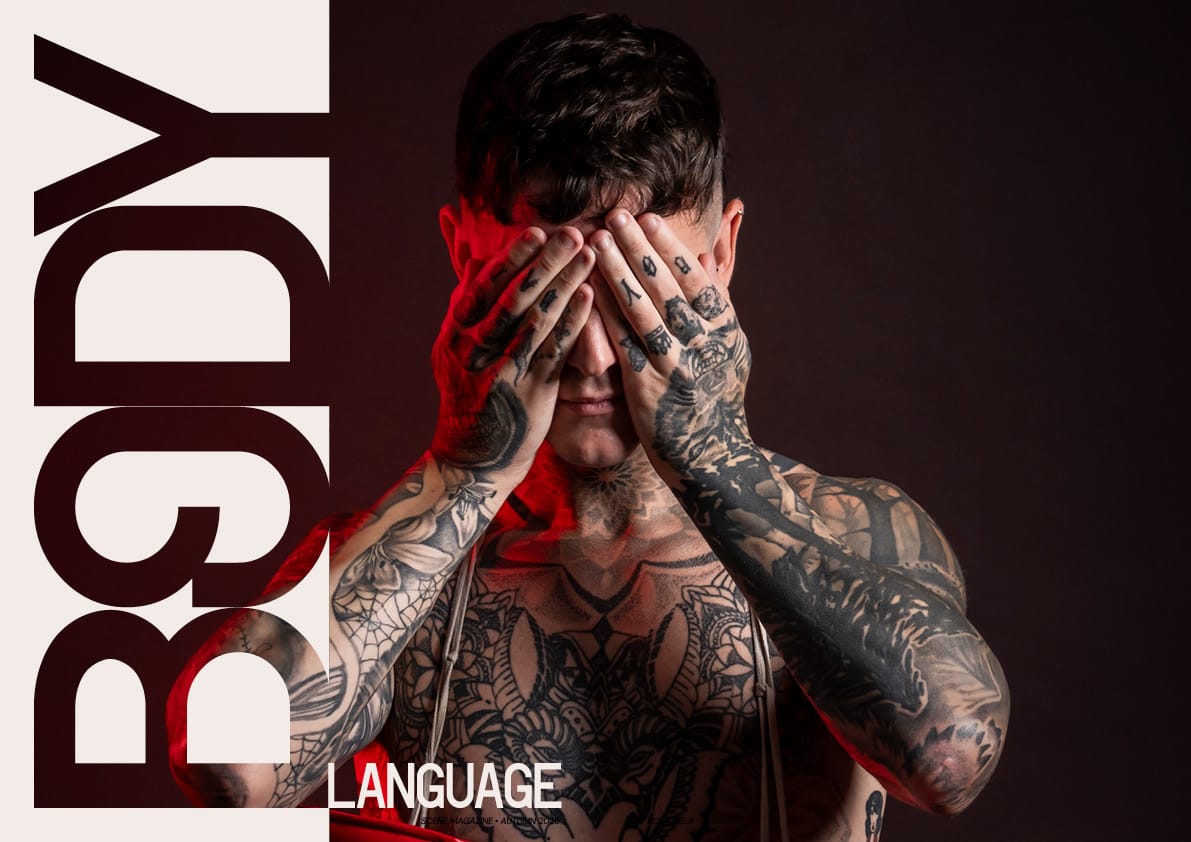
Marking the body is one of the oldest acts of self-expression there is. Some of the earliest confirmed tattoos are around five thousand years old, found on the skin of Ötzi, the mummified man discovered in the Alps, though the practice likely predates that by far longer than the archaeological record can show us.
Scarification and piercing carry similarly old and serious histories, particularly across parts of Sub-Saharan Africa, ancient Egypt, South Asia and Mesoamerica, where they are tied to status, faith or rite of passage rather than fashion.
The Western relationship with tattooing took a very different, more tangled route. Sailors picked it up through contact with Pacific and Asian ports from the eighteenth century onwards, bringing tattooing home as a mark of travel and toughness.
By the twentieth century, tattooing in Britain and America had settled into working-class and outsider territory: circus performers, servicemen, bikers, prisoners. Piercing beyond the earlobe followed a similar arc, pushed into visibility by punk in the 1970s and the body modification scenes that grew out of it.
It’s in that outsider lineage that LGBTQ+ communities found something useful. Tattoos and piercings became a way to signal identity to people who might recognise it, and to claim a body that mainstream culture too often tried to police or erase. Gay leather and BDSM subcultures, particularly from the 1970s onwards, developed their own codes through ink and steel, drawing heavily on a hypermasculine visual language, an influence Tom of Finland’s work both reflected and helped shape. During the AIDS crisis, tattoos became a way to mark grief, survival and remembrance at a time when so much loss went otherwise unrecorded.
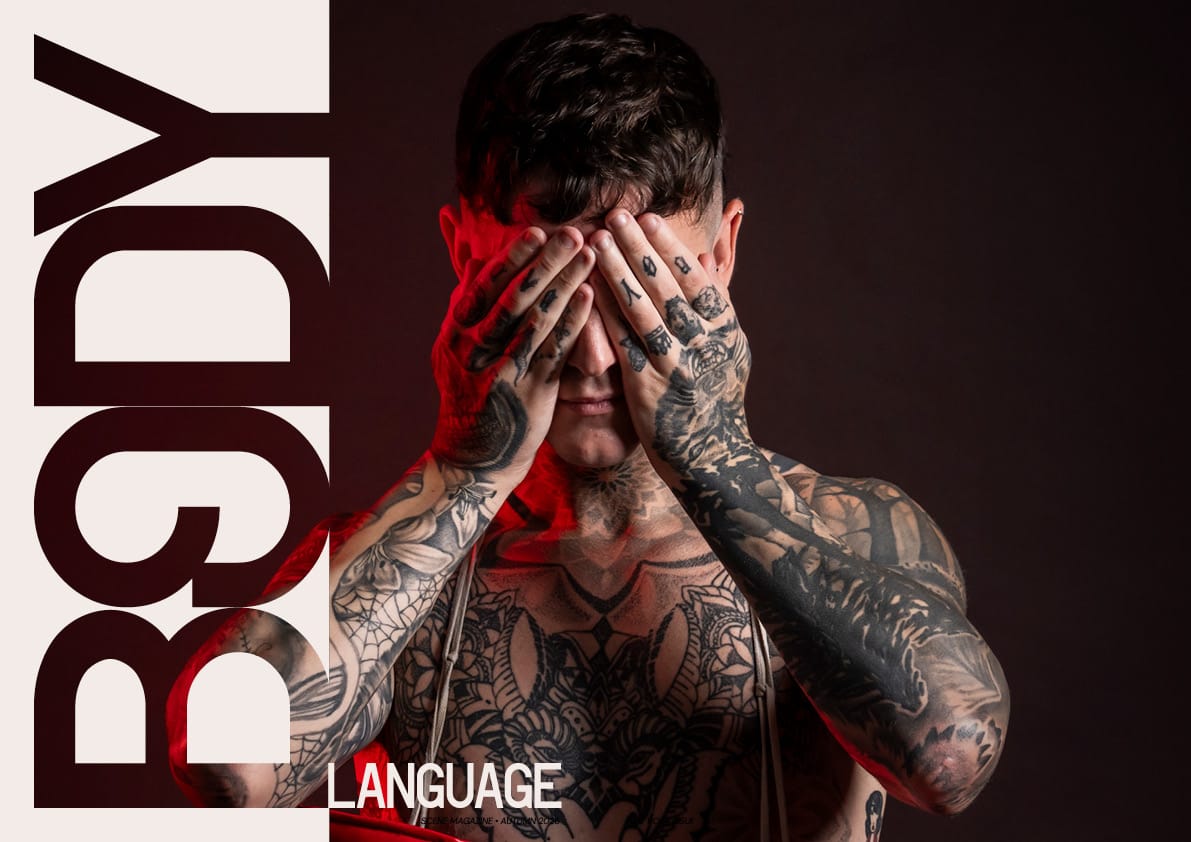
For the people in this project, a tattoo or piercing is rarely just aesthetic. It can mark a transition, stand in for a body part or a person no longer there, or reclaim skin that once felt like it belonged to someone else’s expectations rather than their own. Each of the pieces shown carries a specific story rather than a general one, told directly by the person wearing it.
Modification as identity is not a new idea. LGBTQ+ communities didn’t invent the practice of marking the body with meaning, but they have made it their own, folding it into decades of finding one another, protecting one another and telling the truth about a life on the skin where words alone sometimes fall short.
See more at: Body-Language.co.uk
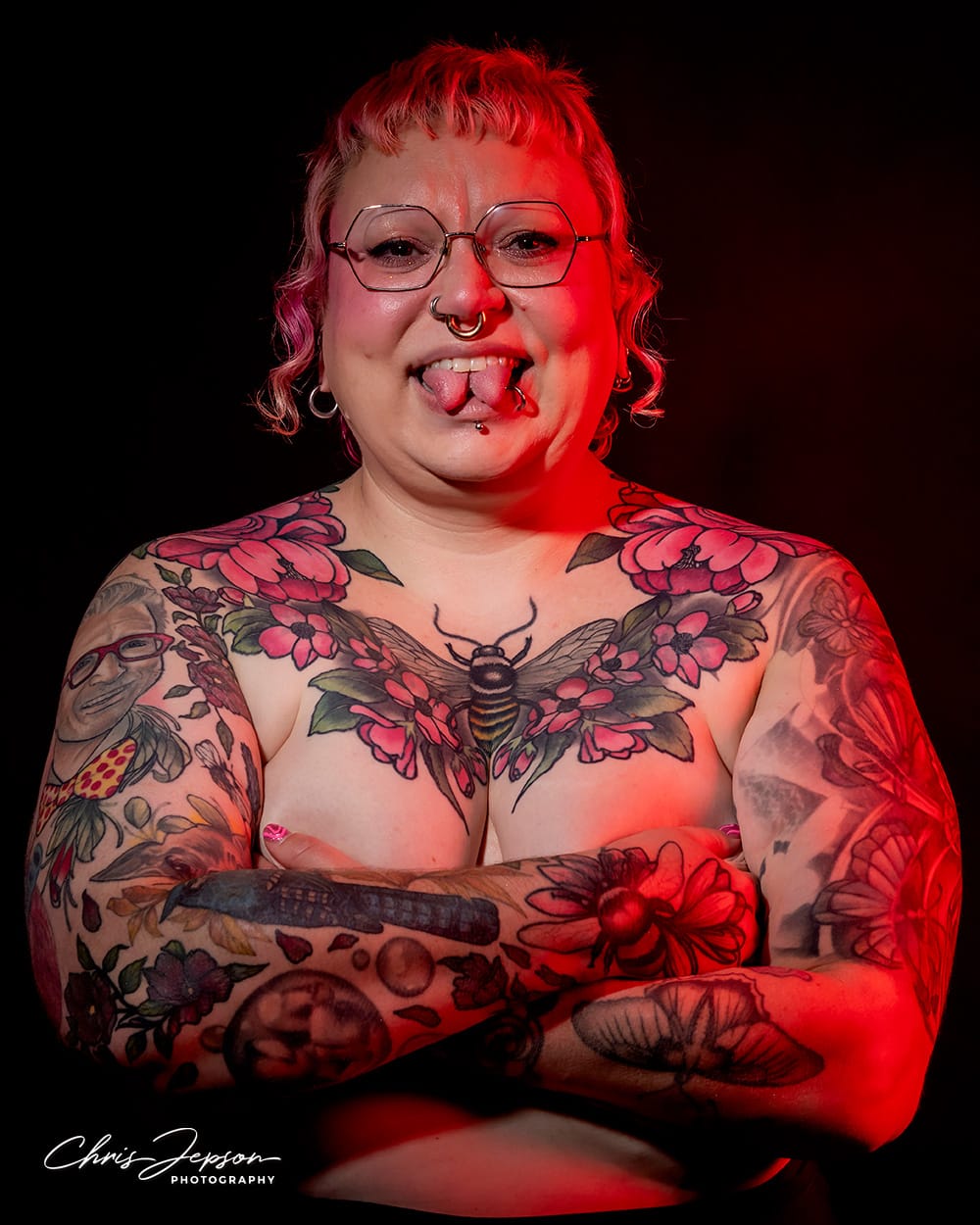
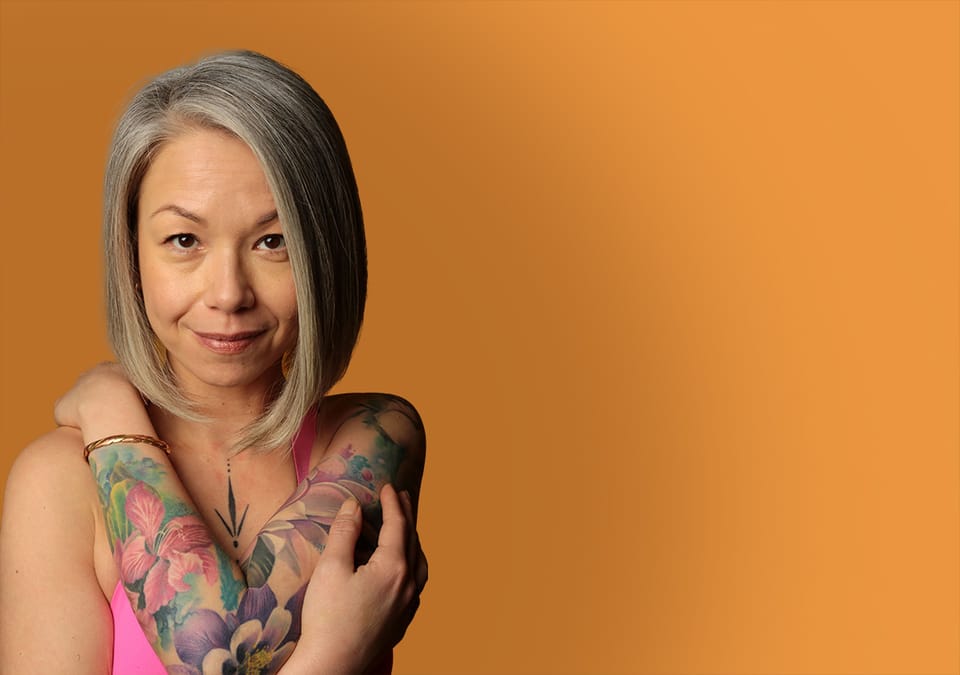
Terri’s body has been a work in progress for thirty-six years. It started small, ears pierced at five, decisions made by someone else about a body that was, in every sense, still theirs. At fourteen they began making those decisions for themselves, and by their early twenties had turned that curiosity into a craft, working as a body piercer specialising in bespoke work, suspension, scarification and the more extreme end of genital piercing.
Piercing other people taught them something about piercing themselves: modification isn’t decoration, it’s a way of saying something the body couldn’t say before, marking a change, standing in for what’s been lost, or simply taking ownership of a form that wasn’t always theirs to shape. Terri is non-binary and heavily tattooed, with more skin still to cover before they’d call themselves finished. Every piece marks a point along the way, and this project is a chance to talk about that history honestly, not as fashion or subculture, but as the long, ongoing process of making a body that actually belongs to them.
Terri’s featured piece runs from a chest tattoo upward, taking in a stretched septum and a split tongue. The chest piece is a blast-over: the original was done in black and grey, but it stopped matching who Terri actually is, so they went bigger and brighter until it did. The flowers on their shoulders came from simply loving their artist’s flash rather than any deeper meaning, but that piece set the direction for everything since, including an iris thigh piece currently in progress.
The stretched septum and split tongue trace back to reading Modern Primitives as a young person, a book on body modification traditions adapted for modern life, credited with helping ignite the tattoo and piercing renaissance of the 1990s. It gave Terri a language for something they already felt, part of the same ongoing project: shaping a body that is genuinely theirs.
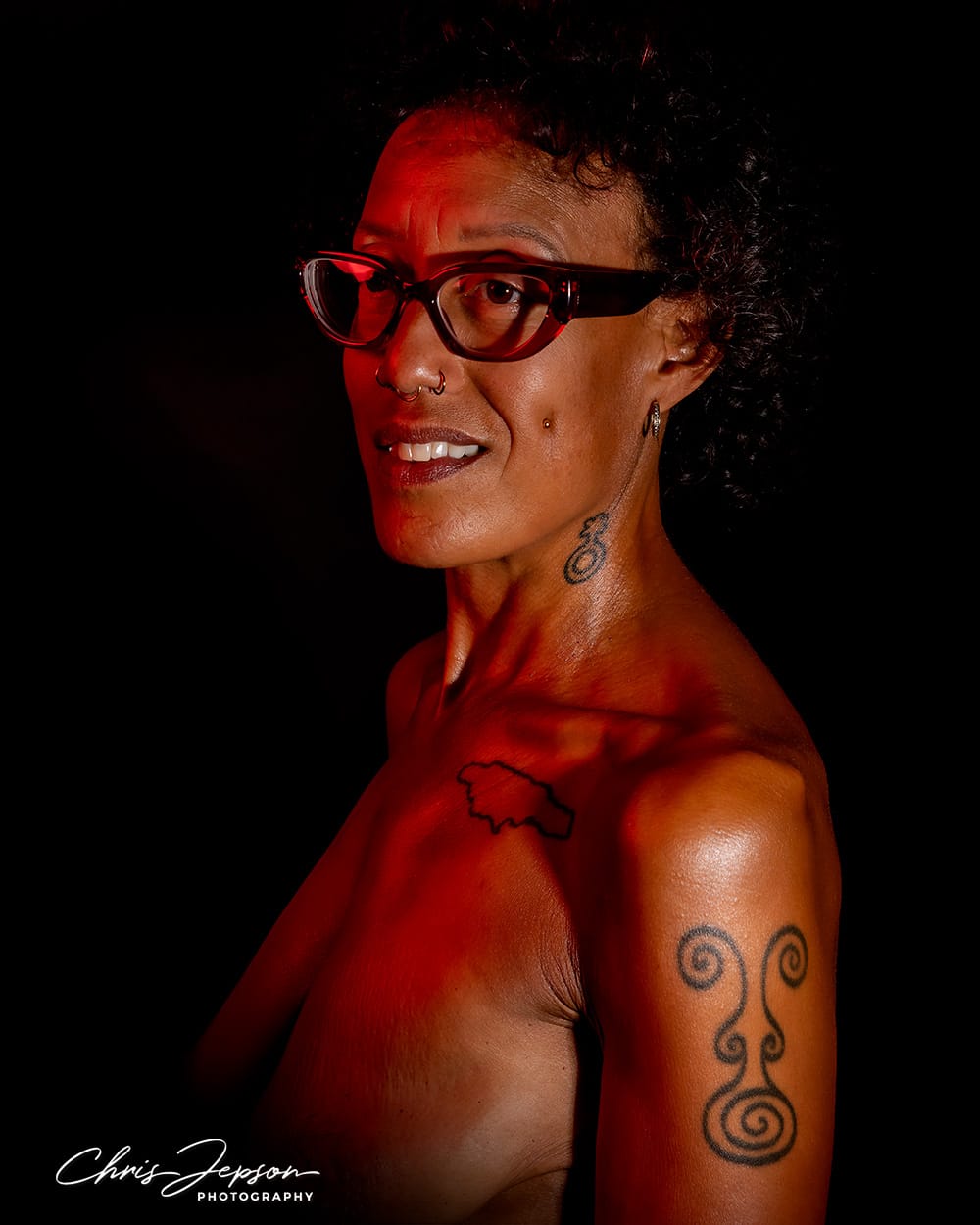
Josetta, who is queer, trans and nonbinary, chose three tattoos from a collection of seven for the portrait that trace a circular story from first to most recent.
The oldest is a set of spirals on their left upper arm, representing their own face and body in a style that draws on ancient art and practice. Josetta designed it themselves and had it done around the age of twenty by a friend and fellow queer person of colour from Greenham Common peace camp who was self-taught and learning the craft at the time. They were one of a group of “Greenham dykes” who got tattooed together during a holiday in the wilds of Cornwall. An outline of Jamaica above their heart marks their connection to heritage via their father, who was from the island, and the most recent is a nonbinary symbol on their neck. All Josetta’s tattoos represent deeply meaningful connections to communities, culture and spiritual practices.
Josetta’s background is in yoga, mindfulness, wellbeing, mental health advocacy, and social justice, working with people of colour (POC), LGBTQIA+, trans and nonbinary, and neurodivergent/disabled people. They are currently focused on doctoral research, training and consultancy in equity, diversity and inclusion for these communities. They love being Black, queer, nonbinary, intersex, autistic and having ADHD, and working with marginalised communities.
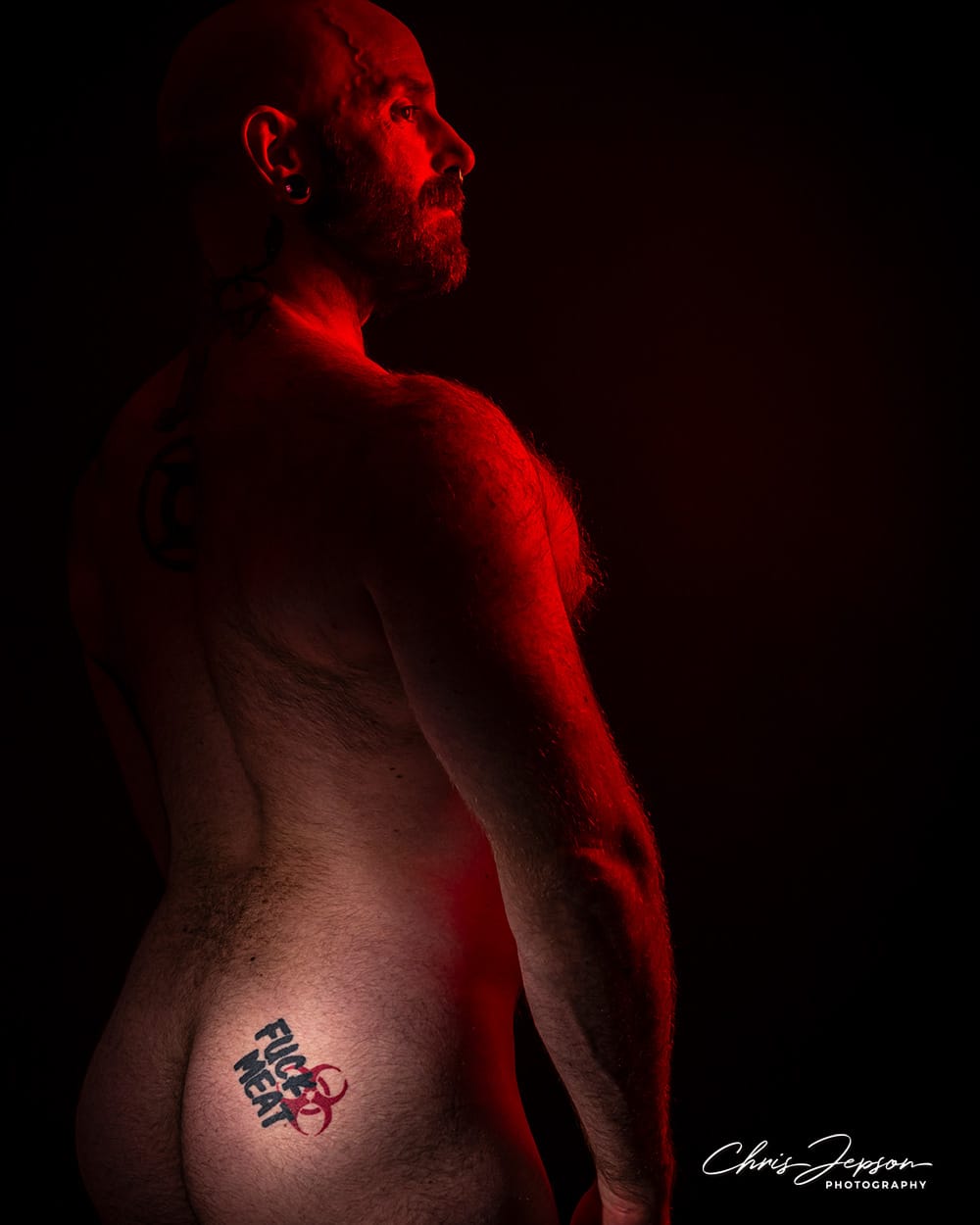
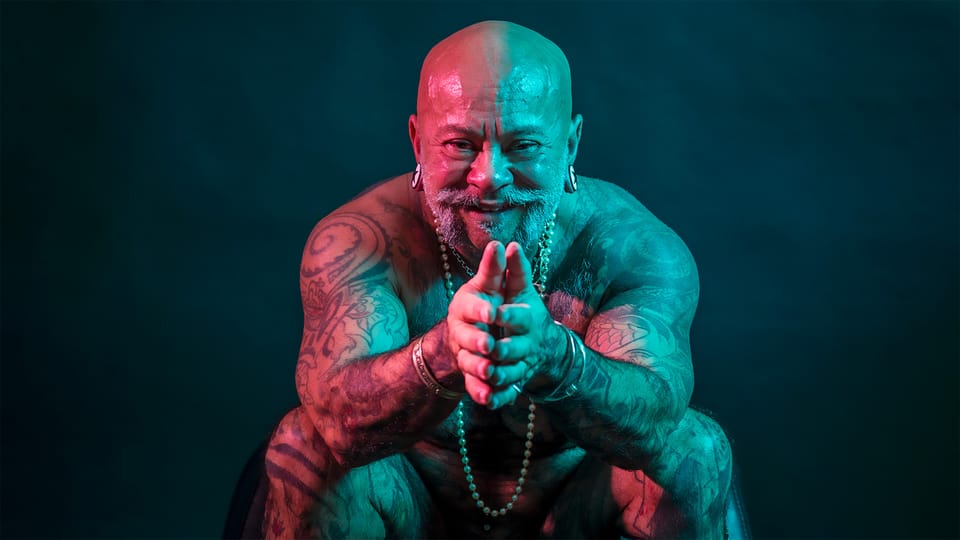
They don’t tell you this about exhibitionism, but having comfort in exposing yourself doesn’t mean you have comfort in yourself. I spent many years exploring all sorts of kinks and fetishes and general faggotry, yet I struggled so much to like my body, and myself. I often transformed myself into roles that others would define for me, because becoming what they wanted meant I was desired and accepted.
Towards the end of my 30s I hit a wall. Many people saw me as a Daddy; wanting me to dominant and fuck, and I hated it. I’ve been a submissive little pig for as long as I can remember, but I had lost my identify by trying to fit in.
That’s when I started my collection of queer tattoos. They are an approval; an acceptance by myself of myself. They serve as a reminder of exactly who I am, who I want to be, and grant me permission to focus on having the type of connections that I want.
They don’t teach you this in school, but life isn’t best lived by fitting in. It’s best lived by making space for yourself and inviting others in to share the things that make you whole.
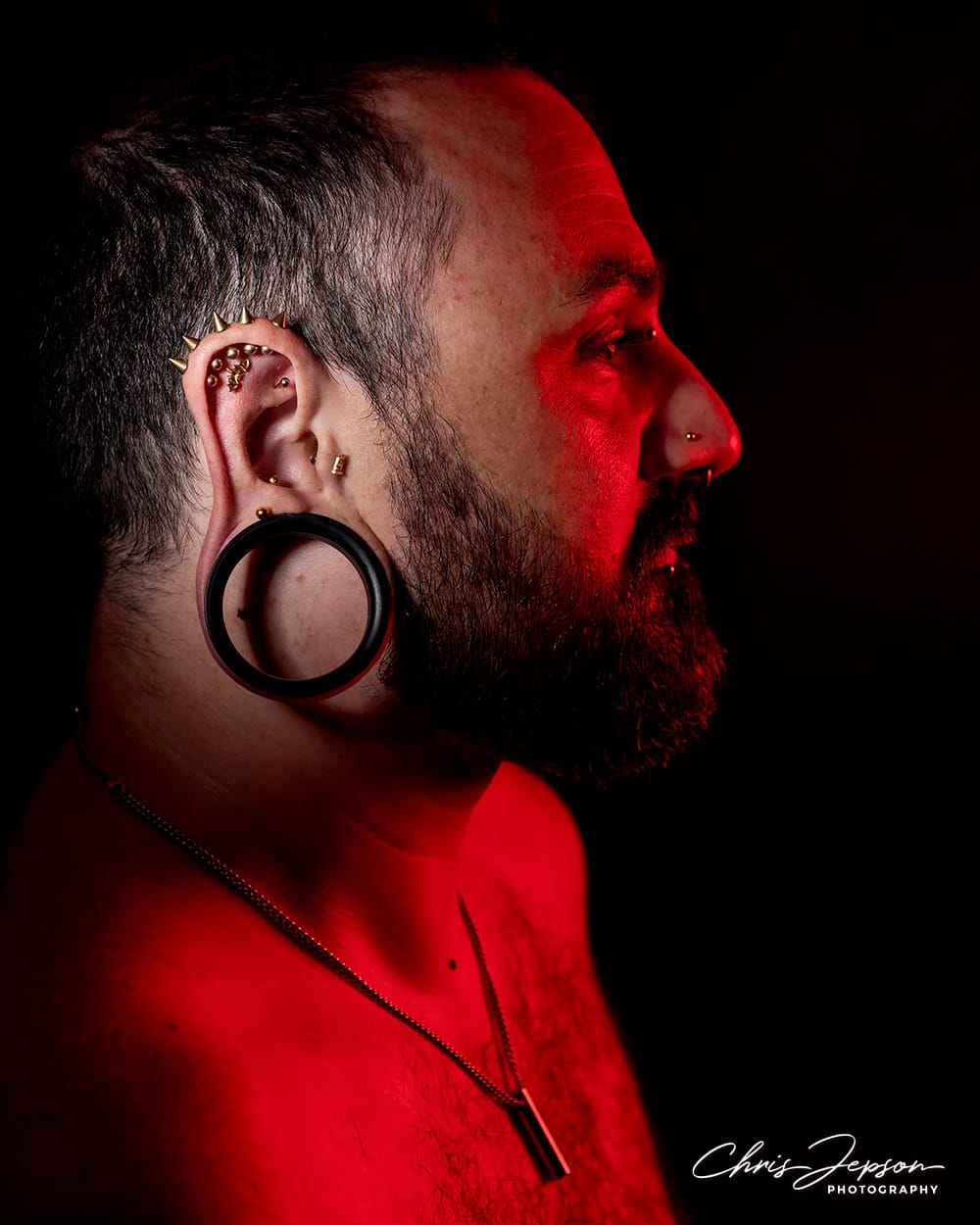
Elliot is a 38-year-old queer man, born in Jersey, who moved to Brighton for university in 2007. He’s now a body piercer and manager of Punktured Body Piercing in Brighton’s North Laine.
Growing up on a small island and coming out in his early teens wasn’t easy. Intense bullying and rejection led him to internalise the idea that his queerness made him weak, worth less than other men, and that everyone now expected him to fit a stereotype. He found piercing at sixteen, and it began as an outright rejection of what people told him a gay man should be. He wanted to show he was hard, that he could do what other men could, that his queerness didn’t mean mental or physical weakness, proof to himself that he was strong, and armour against the negativity around him.
It was only as his relationship with body piercing developed, to the point where he took it on as a career, that he realised modification wasn’t a rejection of his queerness but an extension of it. He wanted to stand out rather than blend in, to be looked at rather than ignored, to have his differences, sexual and physical, celebrated as something worn proudly on the outside. He wanted his body to be as queer as he was within, without shame.
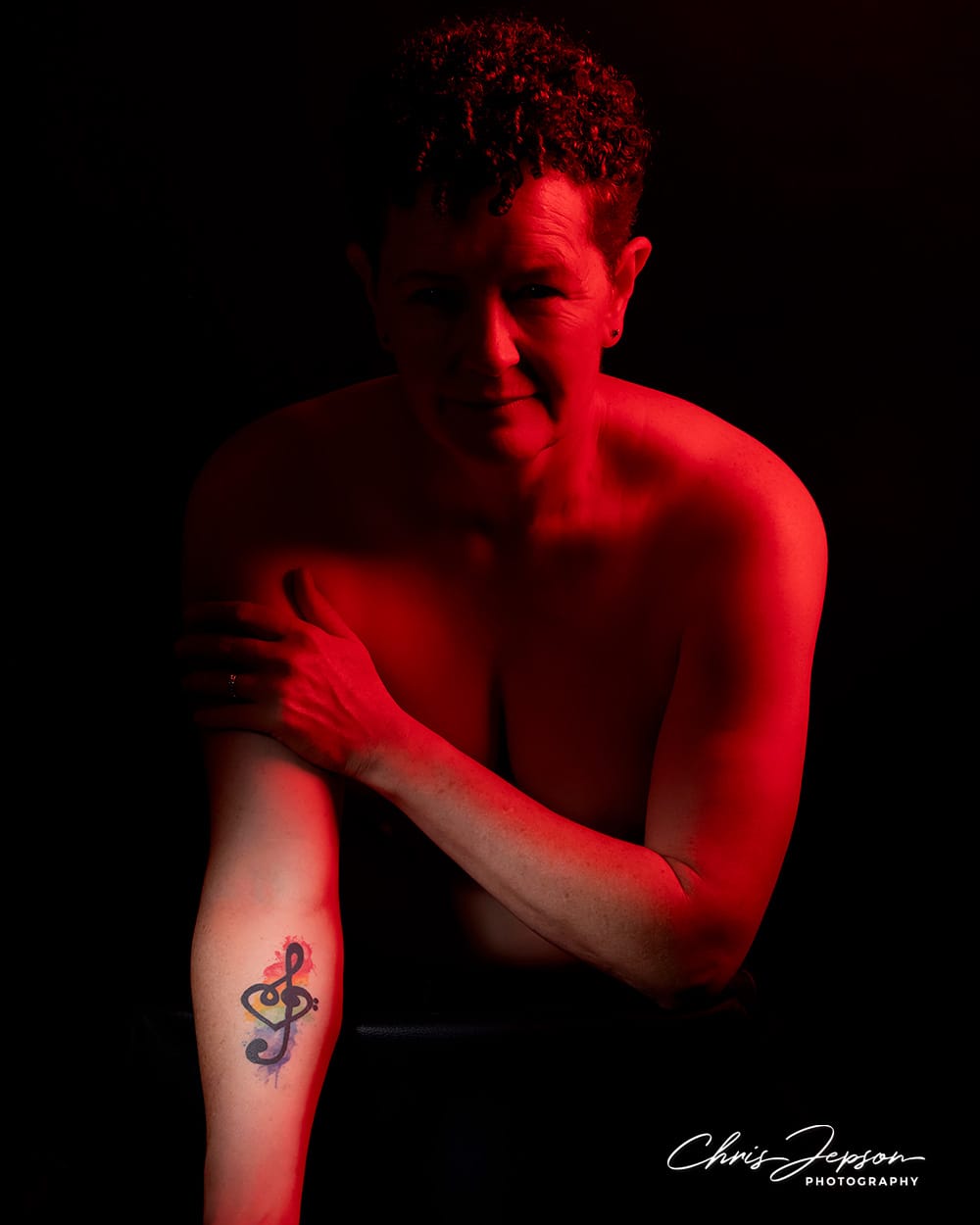
Emma made history as one of the first women to deploy at sea with the Royal Navy. Arrested and discharged in 1993 because of her sexual orientation, she challenged her dismissal at the European Court of Human Rights, contributing to a pivotal change in UK law in 2000.
She joined the Royal Navy at eighteen, when being gay in the military was illegal. About three and a half years later, she told a friend she thought she was gay. The next morning she was arrested, interrogated, had her belongings searched, and was later discharged, her career and identity dismantled for no reason beyond her sexuality. She describes having to rewrite her entire map of the world. Five years on, she found the strength to challenge the ban, taking her case to court and eventually the ECHR, contributing to the ban being lifted in January 2000.
Emma got her tattoo as a fiftieth birthday present to herself. At its simplest it represents her sexuality, her wife and her hobby, singing a cappella, shown through treble and bass clefs together, coloured in pride. More deeply, it marks her arrest, her case at the European Court of Human Rights, and her decision to live as a visible lesbian rather than hide, as she was once forced to.
The design was drawn by her wife, Fran, which makes it especially meaningful to her. She placed it on her forearm deliberately, visible to herself and not hidden from the world, a reminder of resilience and of the strength to do the right thing.
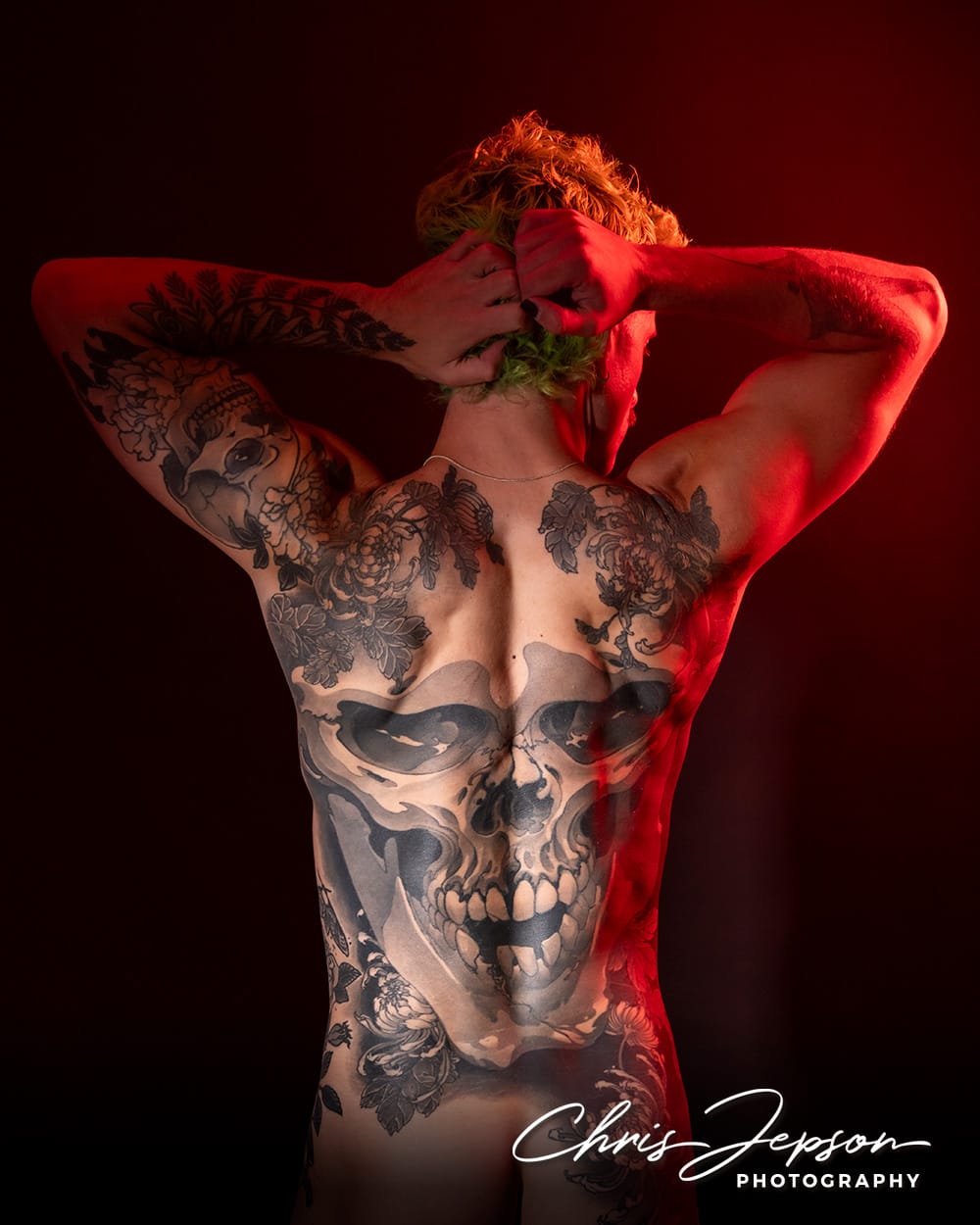
Andrea Walker is a Brighton-based choreographer, director and the founder and Artistic Director of 201 Dance Company. He directed and choreographed SKIN, named “Stand-Out Dance of the Summer” by The Guardian, and SMOTHER, that the four-star Times review called “the new generation of street dance.” His work blends contemporary dance, physical theatre and cinematic storytelling around identity, queerness and human connection.
Originally from Rome, Andrea trained at The Broadway Dance Center in New York and holds a BA in Film and Television Production from the University of Westminster. His work spans Ebony Bones’ European tour, a world premiere for the Joffrey Ballet in Chicago, and SAD BOOK, adapted from Michael Rosen’s book, an Edinburgh Fringe “Top Stage Pick” that toured the UK in 2025. He is currently creating The Last Day, exploring his relationship with his mother and the grief of losing her to cancer, touring in 2027.
As an openly queer artist, Andrea’s work is rooted in visibility and community. He also directs the official Brighton Pride dance video ever year, working with headline artists including Kylie Minogue and Girls Aloud.
Andrea’s back piece marks a turning point that followed his mother’s death after a difficult battle with cancer. It’s tied to a new relationship with death, one he describes as beautiful, and to a way of approaching life that’s shifted completely from where he stood three years ago. The tattoo marks a transition and something reclaimed, a reminder to himself to be brave and outrageous.
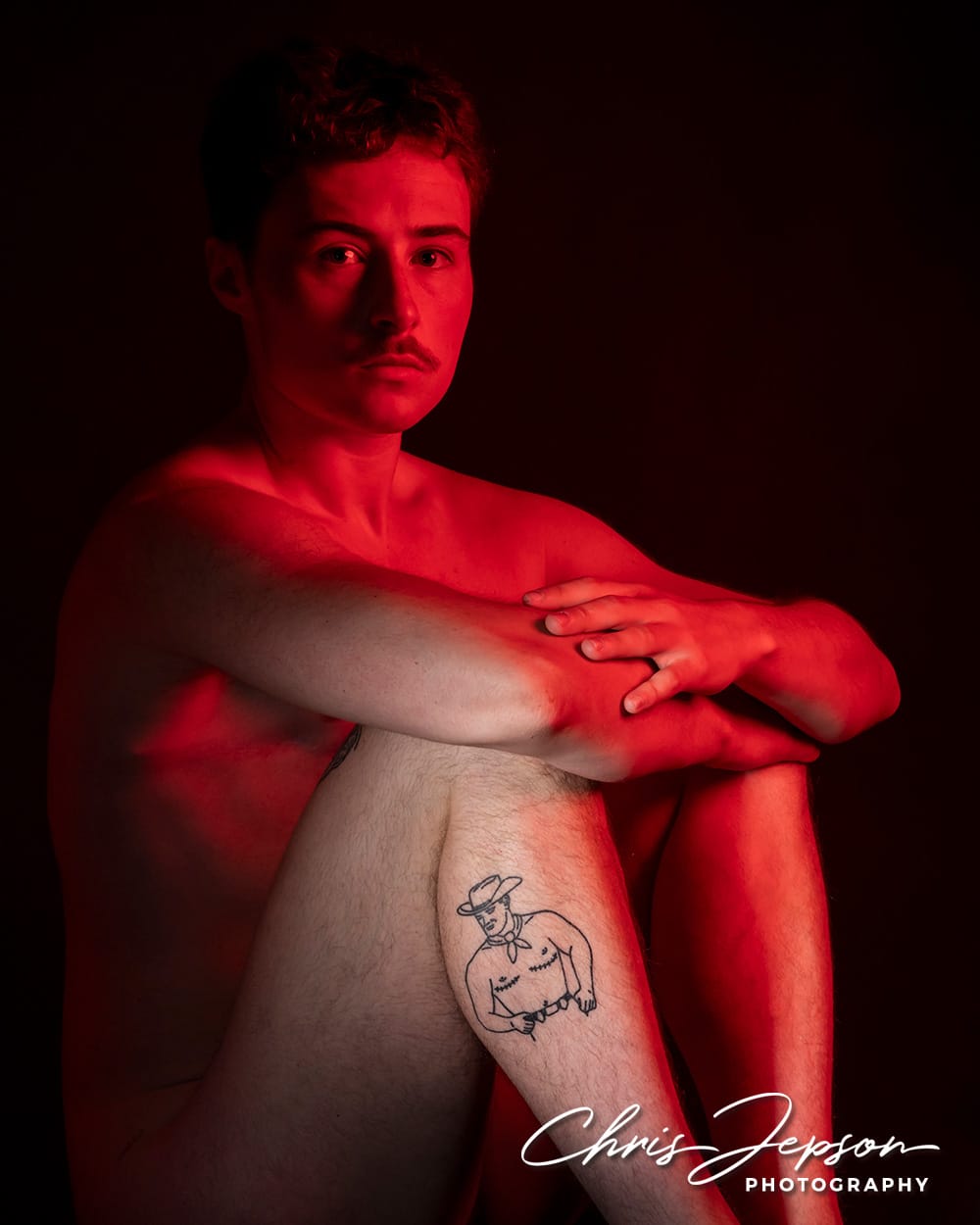
Connor is twenty-five, an actor based between London and Brighton. He is a bisexual trans man who has been transitioning over the past four years.
On the side of his calf, Connor has a tattoo of a topless cowboy bearing top surgery scars, a piece he got to celebrate his own top surgery. Cowboys have long represented a kind of masculinity Connor was drawn to, and giving the figure top surgery scars turned that image into something specifically his: a trans cowboy marking his transition into his own version of that masculinity. The tattoo commemorates his top surgery and the wider transition it’s part of.
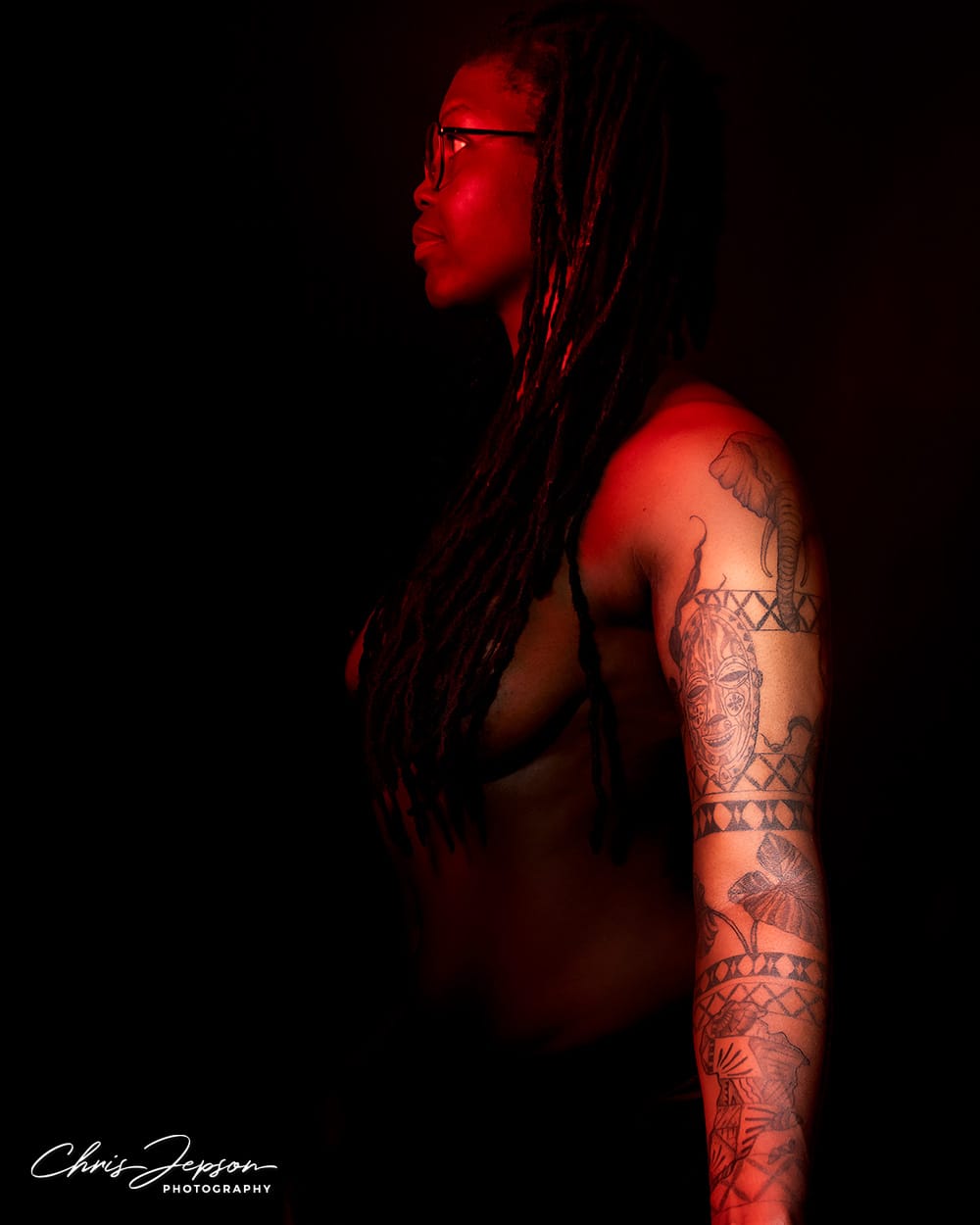
Enor is a 45-year-old Black masc gay woman, born and raised in London and now living in Hove. Her identity, heritage and life experiences are all important parts of who she is, and as she has grown older, she’s developed an even deeper appreciation for where she comes from and the different influences that have shaped the woman she is today.
Her father was Nigerian and her mother is Gambian, but she and her siblings weren’t taught their parents’ languages, and as an adult she’s felt a growing desire to reconnect with parts of her African heritage that weren’t passed down through language. She wanted her skin to tell a story that felt entirely her own, one reflecting her roots and heritage while celebrating strength, resilience and the generations who came before her. For Enor, Africa represents ancestry, belonging and pride, and the sleeve is a way of carrying that connection visibly.
African masks and art were part of Enor’s childhood home, and as a young adult her mother would return from visits to The Gambia with wooden carvings for her, including a mask of her own.
The finished sleeve brings together Enor’s Nigerian and Gambian heritage, her family, her memories, and her identity as a Black masc gay woman. To her, it’s more than body art. It is a celebration of identity, ancestry and belonging – a way of honouring and reconnecting with her heritage, and a personal story permanently written on her skin that she wears with pride.
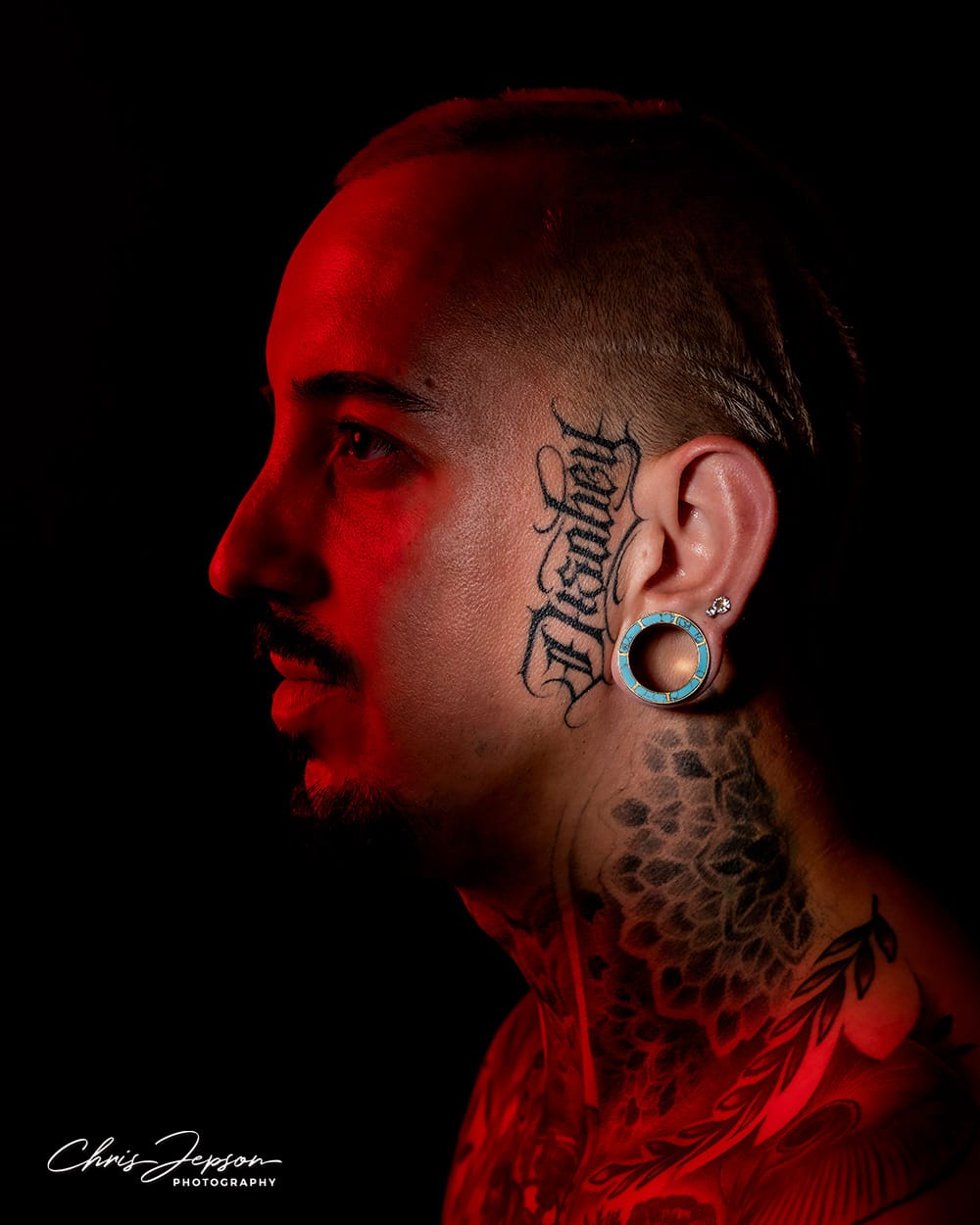
For Harry, “Disobey” is less about breaking rules and more about refusing to keep making himself smaller for other people.
Growing up, he became very good at editing himself – knowing what to say, what not to say, how loud to be, how much of himself was safe to show. The tattoo came from reaching a point where he simply didn’t want to do that anymore.
There’s a long history of queer people being told how to behave, who to love, how to dress and when to stay quiet. A lot of the progress queer people have made came from those who were considered difficult, disruptive or simply unwilling to obey. Having “disobey” permanently written across his face feels like a small nod to that history.
And then there’s the rest of him. His tattoos aren’t a carefully curated collection — they’re more like a physical map of an ADHD brain: impulsive decisions, strange ideas, things he loves, things that make him laugh and things that mean something only to him. His appearance is constantly evolving, and he likes it that way.
It’s messy, excessive and probably a little bit inappropriate.
Which feels pretty fucking appropriate.
See more at: Body-Language.co.uk
Scene was founded in Brighton in 1993, at a time when news stories about Pride protests were considered radical.
Since then, Scene has remained proudly independent, building a platform for queer voices. Every subscription helps us to report on the stories that matter to LGBTQ+ people across the UK and beyond.
Your support funds our journalists and contributes to Pride Community Foundation’s grant-making and policy work.
Member discussion