

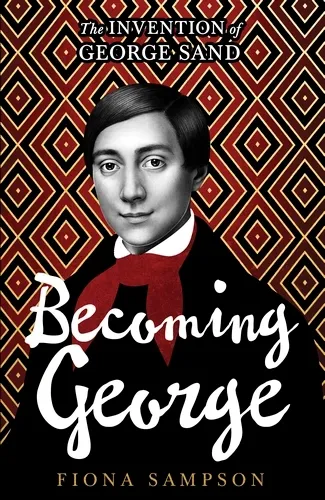
Becoming George by Fiona Sampson
For readers who know that the nineteenth century had more to teach us about gender, desire and creative freedom than the textbooks admit, this book is a revelation. George Sand, who asked only to be taken as she wished, deserves to be taken seriously. Sampson makes that case beautifully.

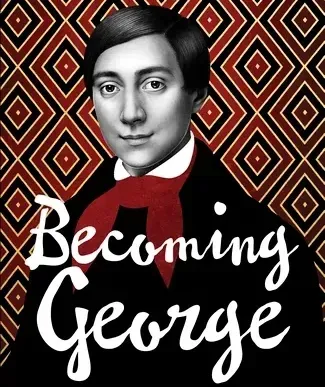
"My friends will respect me, I hope, just as much under my jacket as under my dress... So take me for a man or a woman as you wish."
These words, written by Aurore Dupin; the woman the world would come to know as George Sand, carry across two centuries with startling freshness. They read like a declaration still being made on dancefloors, in courtrooms, and in the pages of contemporary queer fiction. That a woman born in 1804 could speak so directly to us is precisely what makes Fiona Sampson's biography such an electrifying book.
By thirty, Aurore Dupin had remade herself entirely. George Sand, the name an act of creative defiance, had become internationally renowned, her literary experiments outselling Victor Hugo in English translation. Paris was scandalised. She smoked cigars, wore trousers, took lovers of every kind, and broke systematically every rule designed to contain women. Sampson's achievement is to restore Sand to her full intellectual and artistic stature: as the beating heart of French literary culture in her century, and as a figure whose prescience about ecology, politics and gender feels like visionary intent.
Sampson brings to this project the instincts of a detective as much as a poet. She pursues her subject through archives, images and cultural history with such tenacity that the book generates genuine suspense and I caught myself rereading a paragraph in disbelief. This biography is revelation. Sampson illuminates how Sand constructed and repeatedly reconstructed herself against the backdrop of a Europe convulsed by political upheaval and artistic reinvention, and the result reads with the propulsive energy of fiction, it's part intimate memoir, part intellectual thriller, while remaining scrupulously grounded in evidence. It is a rare combination.
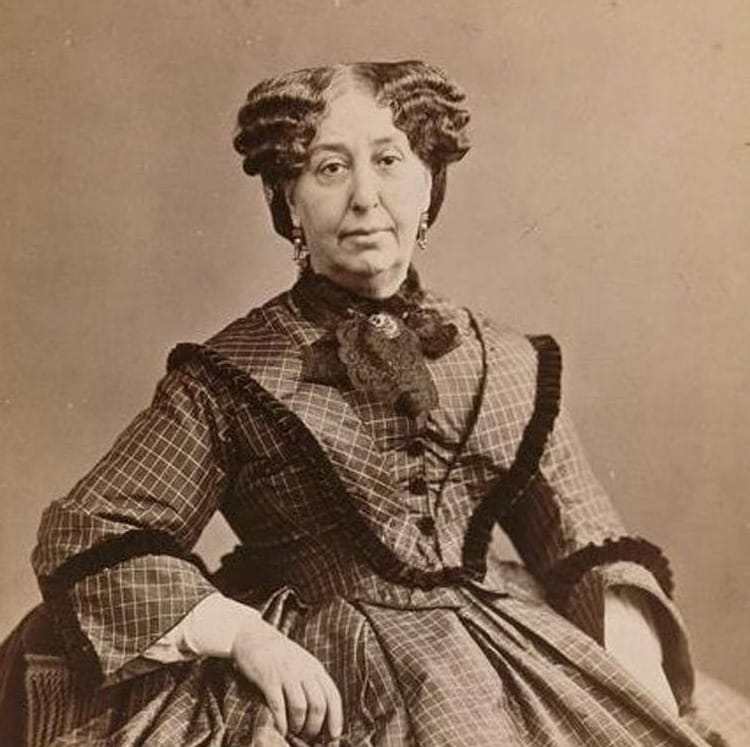
Sampson structures the biography with formal elegance. Narrative chapters charting Sand's life across mass politics and rapid urbanisation are punctuated by interpretive interludes in which she pauses to analyse a portrait or photograph of her subject. Because Sand moved throughout her life in bourgeois circles, she was documented by both portrait painters and photographers, leaving an unusually rich visual archive. The opening impression is particularly resonant: Sand with her granddaughters, just a year before her death, at the country house where she grew up. From this single image, Sampson draws out the full measure of transformation, personal and national, that Sand's long life had witnessed, positioning her as a bridge between the eighteenth century, when a Goethe or Voltaire could reshape European culture from the provinces, and the new Paris-centred modernity that Sand had to inhabit to sustain her astonishingly productive career.
These visual interludes do something else, too. Sampson moves fluently between literature, fine art and music, teasing hidden meanings from images with quiet skill. Her pages on Chopin perhaps Sand's most celebrated lover, are particularly fine, drawing out the ways in which his music and her fiction inhabited a shared emotional and aesthetic atmosphere.
The book is at its most philosophically interesting when it turns on two intertwined questions: what it means to be an author, and what it means to write a life. Sampson acknowledges that biography is always an encounter with the irreducible, that the countless branching choices making up any life resist reconstruction. For a writer, this problem deepens, since the central act of a writer's existence leaves few visible traces. Sand, however, was more gregarious than most, her life laced with complicated, geographically sprawling affairs with famous composers and poets that have given biographers abundant material across the generations.
Where to begin with the texture of the life itself? Sand took younger lovers, male and female, while maintaining intense, unsentimental bonds with the leading male intellectuals of her day, friendships premised on absolute parity at a time when society offered women no such thing. She threw herself into the revolutionary fervour of 1848 with the conviction of a true believer, then pivoted, without apparent contradiction, to advising Napoleon III on how best to bring the artistic classes to heel, pragmatism and principle coexisting in her. Physically, she was fearless: crossing the most vertiginous stretches of the Pyrenees on horseback, covering impossible distances. When her marriage collapsed, she fought for and secured custody of her children despite being a known and unrepentant adulteress, an achievement so improbable in that legal landscape it reads now as pure audacity. Sampson gathers all of this into a portrait of someone who treated her own existence as a medium, shaping and reshaping it with the same restless intelligence she brought to her fiction. The comparison Sampson reaches for is arresting: Sand as an early architect of the essentially queer idea; that identity is something we make rather than inherit.
From a lesbian literary perspective, there is something deeply satisfying about seeing Sand reclaimed in this way. Sampson does not flatten Sand's queerness into biographical footnote. The woman who dressed as a man to move freely through Paris, who loved women, who insisted her friends take her as a man or a woman as they wished, this is the very substance of her radicalism. Sampson's prose acknowledges it with pleasing directness, describing one image as "very dykey" without apology, and tracking Sand's evolution into something altogether harder to categorise or contain. These moments of anachronistic frankness make Sand feel genuinely present.
Becoming George arrives to mark the 150th anniversary of Sand's death and stands as both fitting tribute and genuine reassessment, the first substantial new biography in nearly a quarter of a century. For readers who know that the nineteenth century had more to teach us about gender, desire and creative freedom than the textbooks admit, this book is a revelation. George Sand, who asked only to be taken as she wished, deserves to be taken seriously. Sampson makes that case beautifully.
Out now Hardback £22.00
Becoming George by Fiona Sampson is published by Penguin for more info or to buy the book.
Scene was founded in Brighton in 1993, at a time when news stories about Pride protests were considered radical.
Since then, Scene has remained proudly independent, building a platform for queer voices. Every subscription helps us to report on the stories that matter to LGBTQ+ people across the UK and beyond.
Your support funds our journalists and contributes to Pride Community Foundation’s grant-making and policy work.





Member discussion