

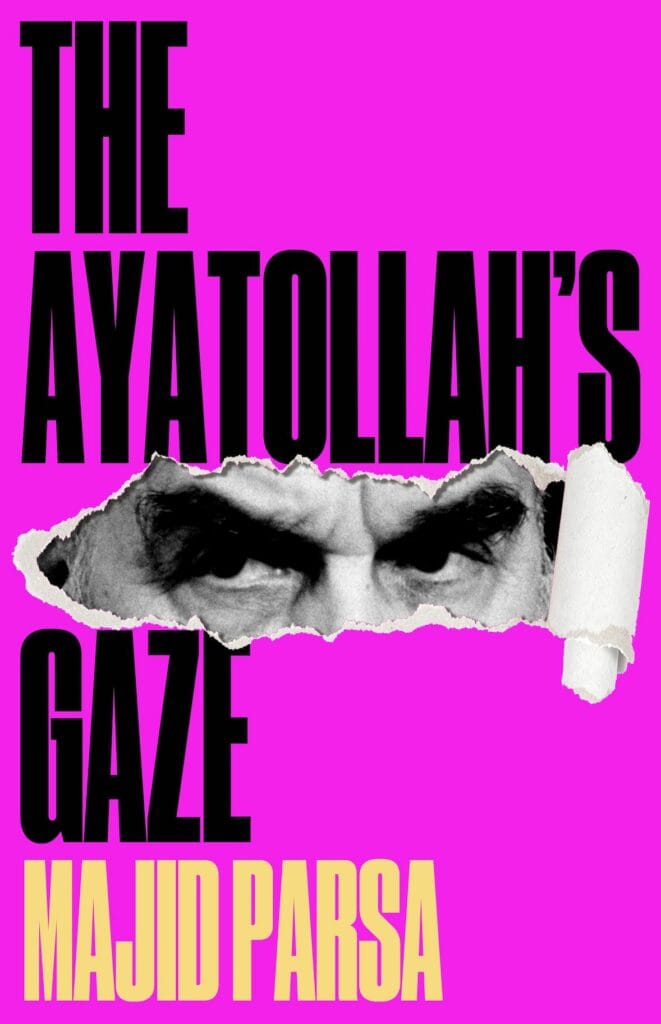
REVIEW: 'The Ayatollah's Gaze' by Majid Parsa
A sharp, hard, and oh so funny coming-of-age story that refuses to apologise, about the accumulation of identities that never quite resolve into one another but fuel a fabulous life.


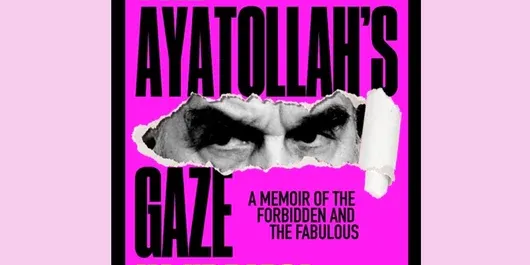
There is a specific ache that comes from growing up between two versions of yourself, and Majid Parsa's debut memoir, The Ayatollah's Gaze, sits squarely inside that ache and makes something luminous out of it.
The call to dawn prayer drifting over rooftops as worshippers head to the mosque, while elsewhere in the same city, that same sound is the cue for a different kind of gathering to disperse. Sweat still cooling on their skin, smiles lingering, the queer men of Tehran melt back into ordinary daylight life, already trading whispered plans for where and when they'll reconvene. It's this double existence, sacred and forbidden occupying the same streets, sometimes the same hour, that Parsa renders with such unsparing clarity, pulling back the curtain on a scene that is endangered and defiantly alive, thriving in the blind spot of a regime built to erase it.
Parsa born in Sheffield, returned to Iran when he was still a baby, after his parents grew devout in the aftermath of the Revolution. He was raised, inside a household and a society built on strict religious observance; an environment that would later demand he hide the truest part of himself. What follows is a meticulous, often devastating, sometimes riotously funny account of a boyhood shaped by conflict, piety and rigid obedience, and of the teenage awakening that quietly, irrevocably, cracked that obedience open into something closer to pride.
It's an account of what it means to come of age queer in Iran through the 1990s and 2000s, when desire itself was a crime punishable by death. Parsas' prose is determined to leave nothing softened for comfort's sake, lifting the veil on a flamboyant, unapologetic gay scene operating in defiance of both the morality police and the vast, watching authority of the Ayatollah himself.
Writing under a pseudonym, Parsa is candid that migration, from one culture into another, and then back again, leaves a person suspended somewhere in the middle. This is not a memoir about being gay in Iran, or remigrating to Britain; it's about the accumulation of identities that never quite resolve into one another. Parsa is a second son, an Iranian, a Muslim, a British-born migrant, a gay man, and the book resists flattening any of these into the others.
Structurally, the memoir eschews a clean, linear timeline in favour of something closer to a scrapbook: fragments and recollections drift into one another, connected by feeling rather than chronology. It asks more of the reader; you have to work to track which version of Parsa you're with at any given moment, but that disorientation feels deliberate. The self, this structure suggests, isn't just what's spoken aloud; it's also the silences, the omissions, the things a family agrees never to name.
The book is effective in its refusal to simplify. Parsa doesn't offer up Iran as a monolith of repression, nor does he offer a straightforward redemption arc once he reaches Britain. Instead, readers are given an unflinchingly intimate, often joyous portrait of an underground gay scene, parties, romances, chosen family, thriving in defiance of the morality police and the ever-present shadow of clerical authority.
It sits comfortably alongside Abdellah Taïa's autobiographical fiction in its refusal to sanitise queer Muslim desire for a Western gaze, and shares something of Marjane Satrapi's Persepolis in its portrait of an ordinary life lived under extraordinary political weight; though here, the stakes of visibility are rendered ever sharper.
For LGBTQ+ readers, and especially those from religious or diasporic backgrounds, this book will land somewhere tender. It captures, with rare precision, the particular vertigo of loving a faith and a family that cannot fully love you back, and the cost, and the necessity, of choosing yourself anyway. It's a story that matters well beyond Iran's borders: a reminder that queer life persists, inventively and defiantly, even where it is outlawed, and that safety in the 'West' doesn't erase the complicated inheritance of where you came from.
This is a memoir that will make you laugh at its cast of unforgettable characters one page and catch your breath the next; a book about survival, but just as much about pleasure, community and the fabulousness that persists even under surveillance. The Ayatollah's Gaze is an essential, big-hearted addition to queer migrant literature, and Parsa's voice, sharp, sensory, unsentimental, wonderfuly waspish and funny announces an exciting new writer.
The Ayatollah's Gaze by Majid Parsa is published by Wilton Square Books, £16.99 more info or to order:
Scene was founded in Brighton in 1993, at a time when news stories about Pride protests were considered radical.
Since then, Scene has remained proudly independent, building a platform for queer voices. Every subscription helps us to report on the stories that matter to LGBTQ+ people across the UK and beyond.
Your support funds our journalists and contributes to Pride Community Foundation’s grant-making and policy work.


Member discussion