



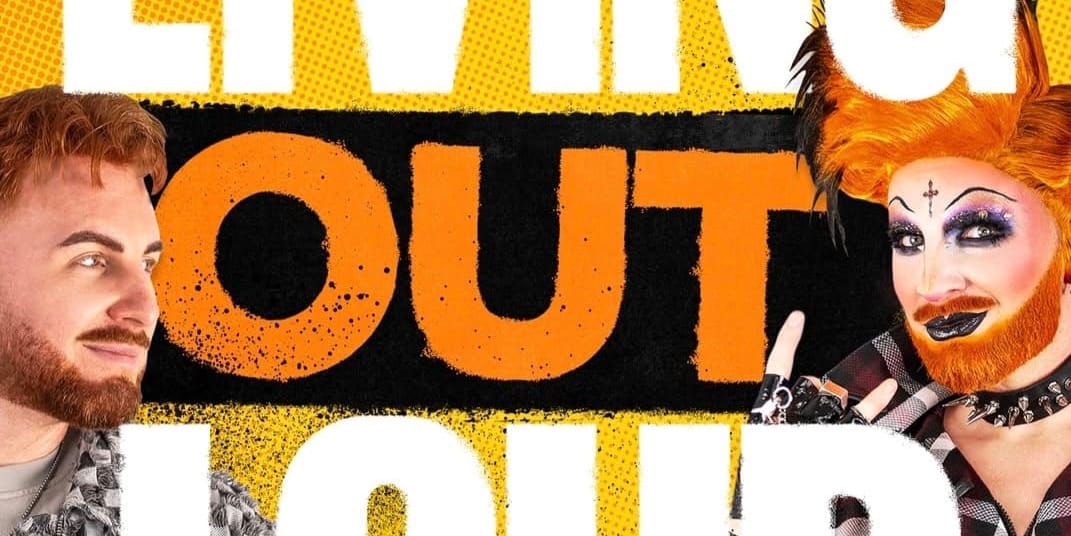
Living out Loud (2026) follows writer, lecturer and drag queen Copper Topp, or Simon Wergrzyn, on their journey to answer the question of how to live an openly queer life in today’s UK.
The answer is undoubtedly to live with acceptance and unapologetic joy.
And yet, with the same name as a poorly received Danny Devito film, Living Out Loud seems to have lost itself in the prime video shuffle.
Directed by Remone Jones, an experienced documentary director with credits like Diddy: Monster’s Fall and What Makes a Killer?, Living Out Loud is incredibly conventional. From sentimental music to found footage montages, it is just like every other documentary, which isn’t necessarily bad for a documentary. In fact, documentaries, more than any other media, thrive on their format. It is not unusual for a documentary to be typical. It is, however, disappointing for a documentary about living loudly to be so dull.
There are so many conversations with truly interesting people in this documentary. However, there are too many conversations for the conversations themselves to be impactful. This is partly because the premise is so ambitious. Simon travels across the UK to explore so many different, intricate parts of the LGBTQ+ identity in under an hour. This leaves us little to no time to sit with the people we are introduced to before jumping to another person with another story and a different place in Copper Topp’s journey to self-acceptance.
Where this is most obvious is in the conversation between Simon and Kate Barker-Mawjee, Chief Executive Officer for LGB Alliance. This is the only conversation within the documentary that is oppositional in nature. However, it is not much of a conversation at all. During the interview, Barker-Mawjee says “it is impossible to change sex, and the rest of the world will not necessarily agree with you.” Simon responds by saying “Everything they stand for, I completely disagree with.” – except, he doesn’t really respond. He waits until Barker-Mawjee has left and he is sat alone to say this. What Barker-Mawjee says is left unchallenged, unconfronted, until she is gone.
To me, this completely undermined the driving message of the documentary. How can we live loudly when we can’t even loudly disagree?
Of course, this makes sense as the target audience is fans of Copper Topp and Drag Race UK, where Copper Topp gained popularity with their appearance on series four. However, it doesn’t offer much for audiences less interested in Copper Topp and more interested in the LGBTQ+ community, which is what the documentary purports to be about.
That being said, the most emotionally resonant moment of the documentary does come from a revelation of Copper Topp’s personal life, as they plant a pansy at the site where they were hate-crimed years before. The final shot of the documentary being that lone pansy, swaying in the wind. This is a marrying of these two aspects of the documentary. It is both about the celebrity Copper Topp and about much more than that, too.
The pansy comes from queer artist and activist, Paul Harfleet. Harfleet began planting pansies to deal with his own experiences of homophobic attacks in Manchester and said of the planting, “I remembered the planting and not the experience.” The conversation is interspersed with pictures of planted pansies, which would be unassuming without their context. This is something Copper Topp alludes to when they say of the pansy that it is “quietly radical.”
This is also how I would describe the documentary. It has some quietly radical moments which are worth watching but suffers because it is not as unapologetic as it should be: It is a documentary that asks you to pay attention, when really it should demand you to.
You can watch Living Out Loud on Prime Video and Tubi now.
Scene was founded in Brighton in 1993, at a time when news stories about Pride protests were considered radical.
Since then, Scene has remained proudly independent, building a platform for queer voices. Every subscription helps us to report on the stories that matter to LGBTQ+ people across the UK and beyond.
Your support funds our journalists and contributes to Pride Community Foundation’s grant-making and policy work.





Member discussion