

Amnesty urges Turkish authorities to drop "unfounded charges" against people linked to an LGBTQ+ rights group
Amnesty International Turkey has urged Turkish authorities to drop what it described as unfounded charges against 11 people linked to an LGBTQ+ rights group, as their trial began in İzmir today (Wednesday, 8 April).
The defendants, including Kerem Dikmen, a former chair of Amnesty International Turkey, served on the executive and supervisory boards of the Genç LGBTİ+ Association, according to the organisation.
Amnesty Turkey said the case forms part of a broader pattern of pressure on LGBTQ+ organisations and their supporters in Turkey, describing it as a “carefully designed harassment strategy”.
The charges follow a December 2025 ruling by the İzmir 3rd Civil Court of First Instance, which found that five illustrations shared on the group’s social media accounts between 2019 and 2022 amounted to “obscenity” and ordered the association’s dissolution. The decision is currently under appeal.
In October 2025, prosecutors also opened a criminal case against 11 members of the group’s governing body for alleged breaches of Turkey’s Law on Associations. If convicted, they could face up to three years’ imprisonment.
In a statement released ahead of the hearing, Esther Major, deputy director for research in Europe at Amnesty International, said it was “astonishing” that the case had proceeded despite a decision by prosecutors in August 2025 not to pursue obscenity charges relating to the same material.
She said the authorities had first moved to shut down “a vibrant LGBTİ+ rights organisation” and were now seeking to penalise its leadership, calling for all charges to be dropped.
According to Amnesty, the images cited in the case included depictions of kissing figures and some degree of nudity. The İzmir court said the content could encourage individuals towards same-sex relationships and did not align with “societal moral values” or constitutional provisions referring to the family as the foundation of Turkish society.
Separately, the İzmir Chief Public Prosecutor’s Office brought criminal charges against the same individuals under the Law on Associations, including Dikmen and Emirhan Şaşmaz.
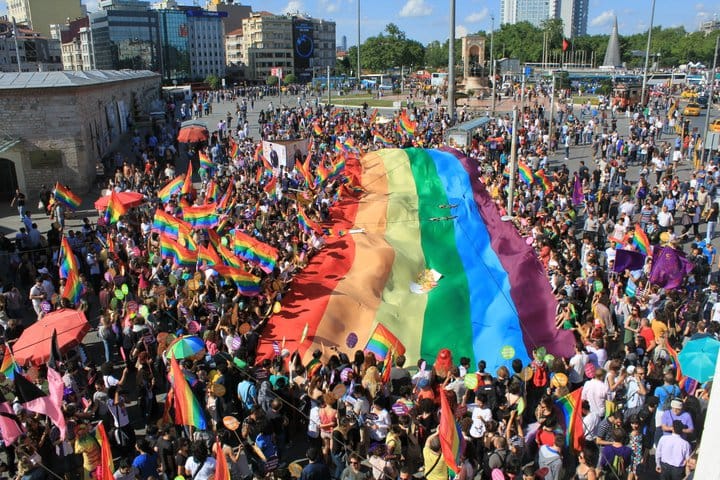
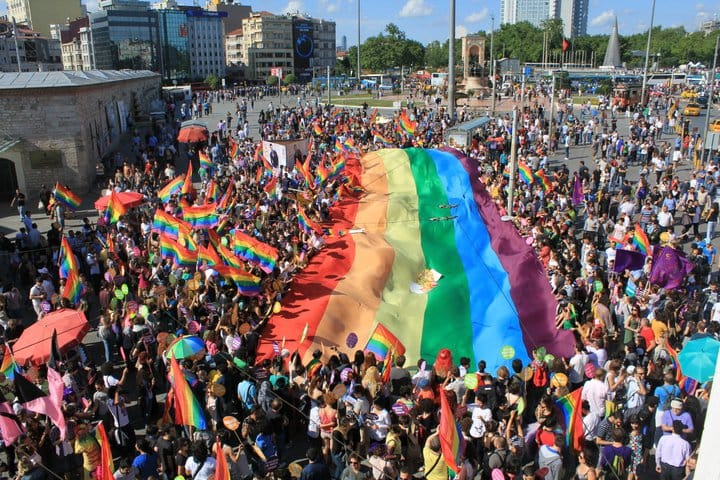
LGBTQ+ organisations have operated in Turkey since the 1990s, and the country was once regarded as relatively open compared with others in the region. Istanbul hosted large Pride marches for years, attracting thousands of participants, before the authorities began banning them in the mid-2010s.
Rights groups say restrictions have intensified in recent years, affecting both public events and civil society organisations. The report said administrative measures, including the closure of associations and the blocking of online platforms, have accompanied legal action.
Turkish President Recep Tayyip Erdoğan and senior officials from the ruling Justice and Development Party (AKP) have in recent years portrayed LGBTQ+ identities as a threat to family values, while promoting policies aimed at increasing birth rates and encouraging traditional family structures.
Support independent LGBTQ+ journalism
Scene was founded in Brighton in 1993, at a time when news stories about Pride protests were considered radical. Since then, Scene has remained proudly independent, building a platform for queer voices. Every subscription helps us to report on the stories that matter to LGBTQ+ people across the UK and beyond.
Your support funds our journalists and contributes to Pride Community Foundation’s grant-making and policy work.
Subscribe today
Comments ()