

How a single poll became a Reform propaganda win — and why you shouldn't fall for it
But look closely at the numbers, and a very different story emerges; one about statistical illiteracy, convenient framing, and the way data can be weaponised without a single figure being wrong.
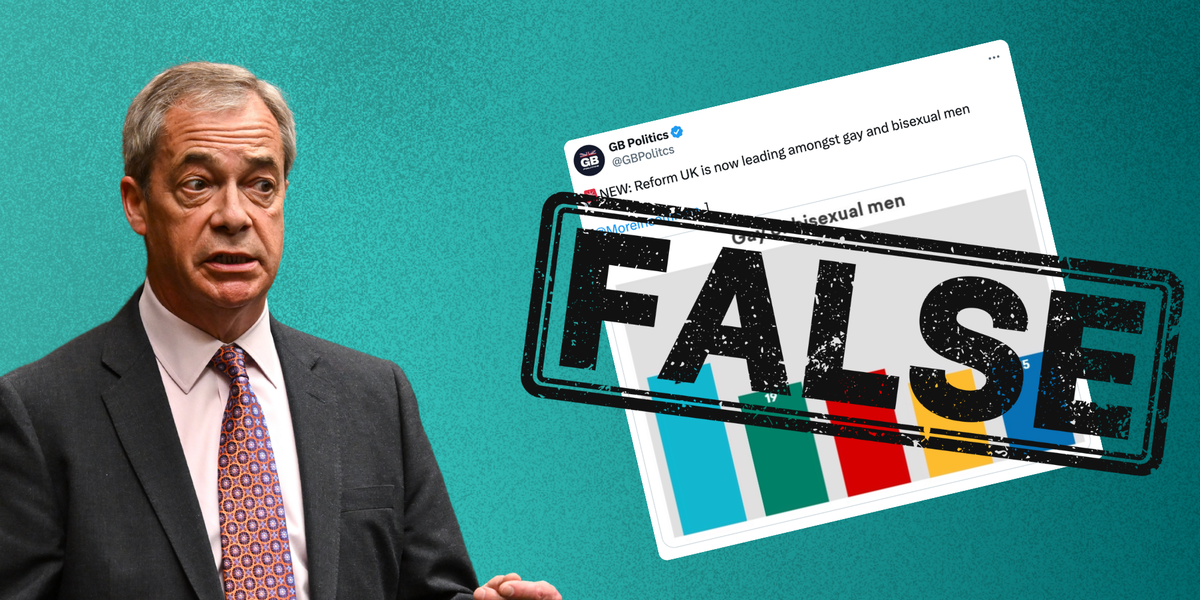
A More in Common survey showing Reform UK leading among gay and bisexual men has been shared widely on social media. But look closely at the numbers, and a very different story emerges — one about statistical illiteracy, convenient framing, and the way data can be weaponised without a single figure being wrong.
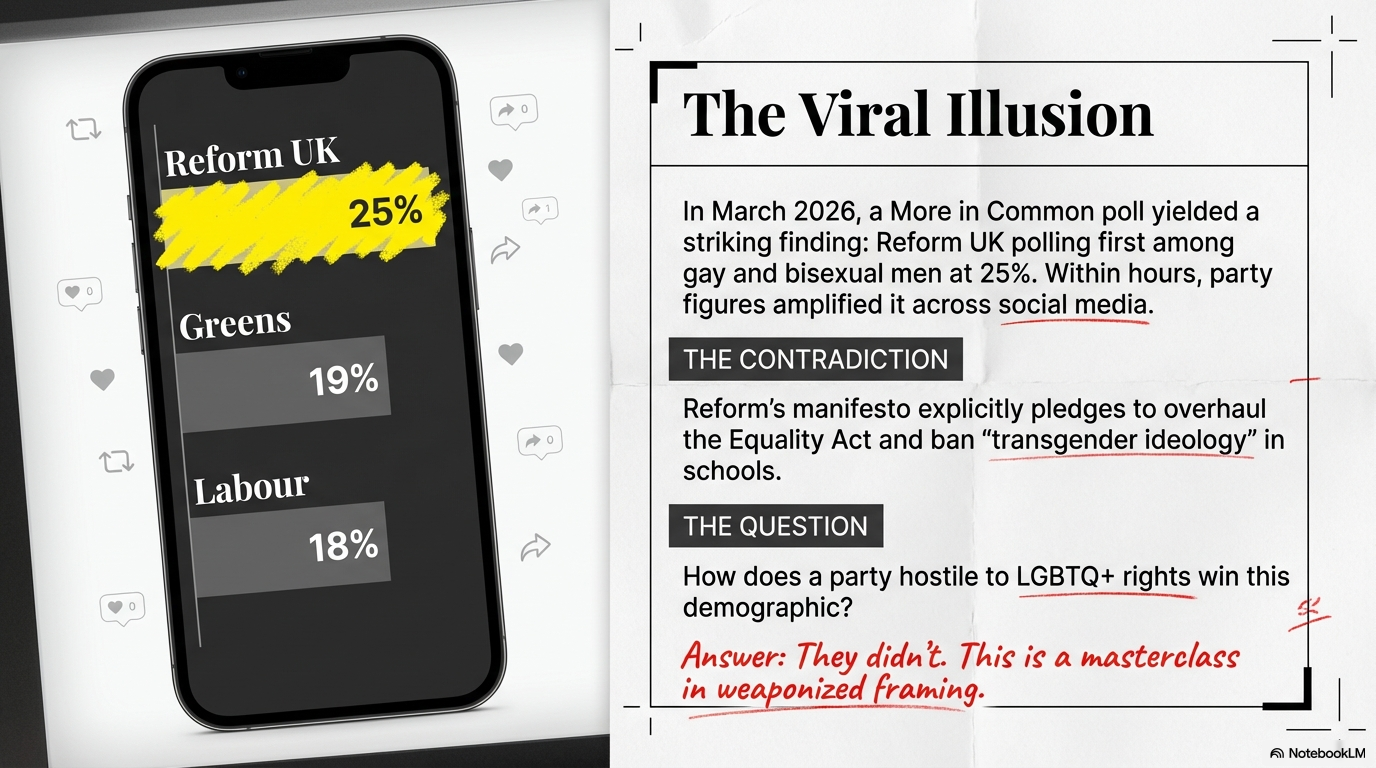
The headline landed with the intended impact. 'Reform UK leading amongst gay and bisexual men,' declared a story circulating across social media last week, accompanied by a colourful bar chart from polling firm More in Common. Within hours it had been amplified by Reform figures including Darren Grimes and Dr David Bull, and was being cited as evidence that the party's appeal now stretched even into communities many assumed would be its fiercest opponents.
It is, on the surface, a striking finding. Reform — a party whose manifesto pledges to overhaul the Equality Act, ban so-called 'transgender ideology' in schools, and whose leader Nigel Farage has stated he did not back same-sex marriage — polling first among gay and bisexual men? That's a story, all right.
The question is: is it the story being told? Or is it a masterclass in how real numbers can be arranged to construct a misleading picture?
Let's go through it carefully. Because every figure below is accurate. And yet the headline fundamentally misrepresents what the data shows.
1. Plurality Is Not a Mandate
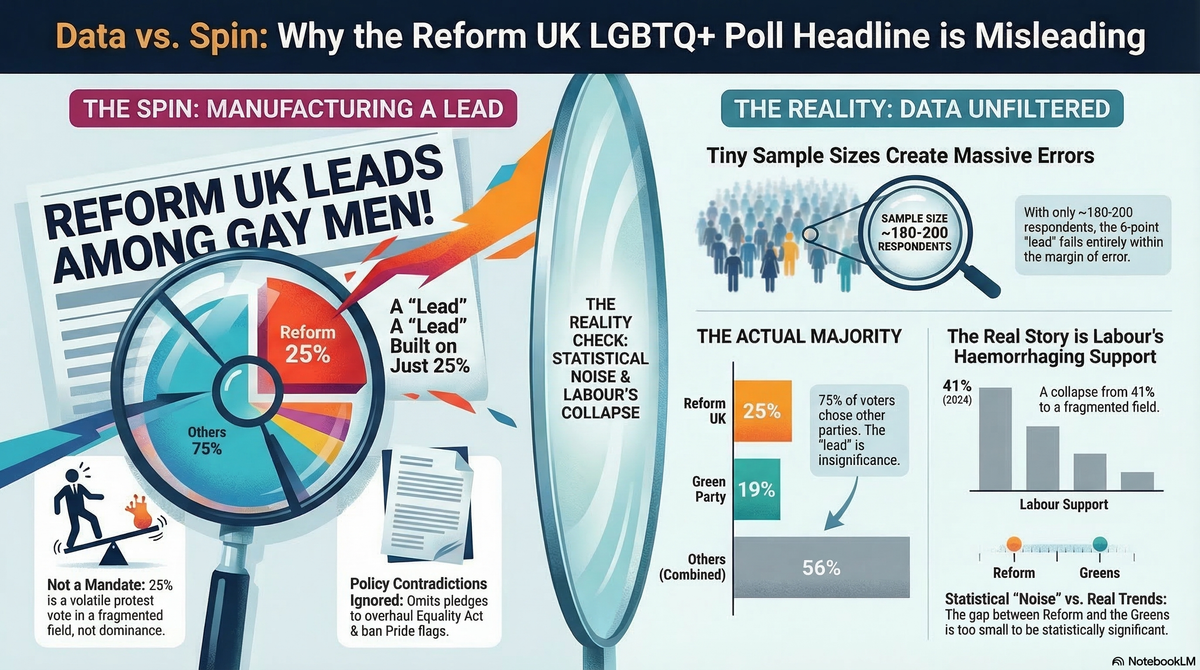
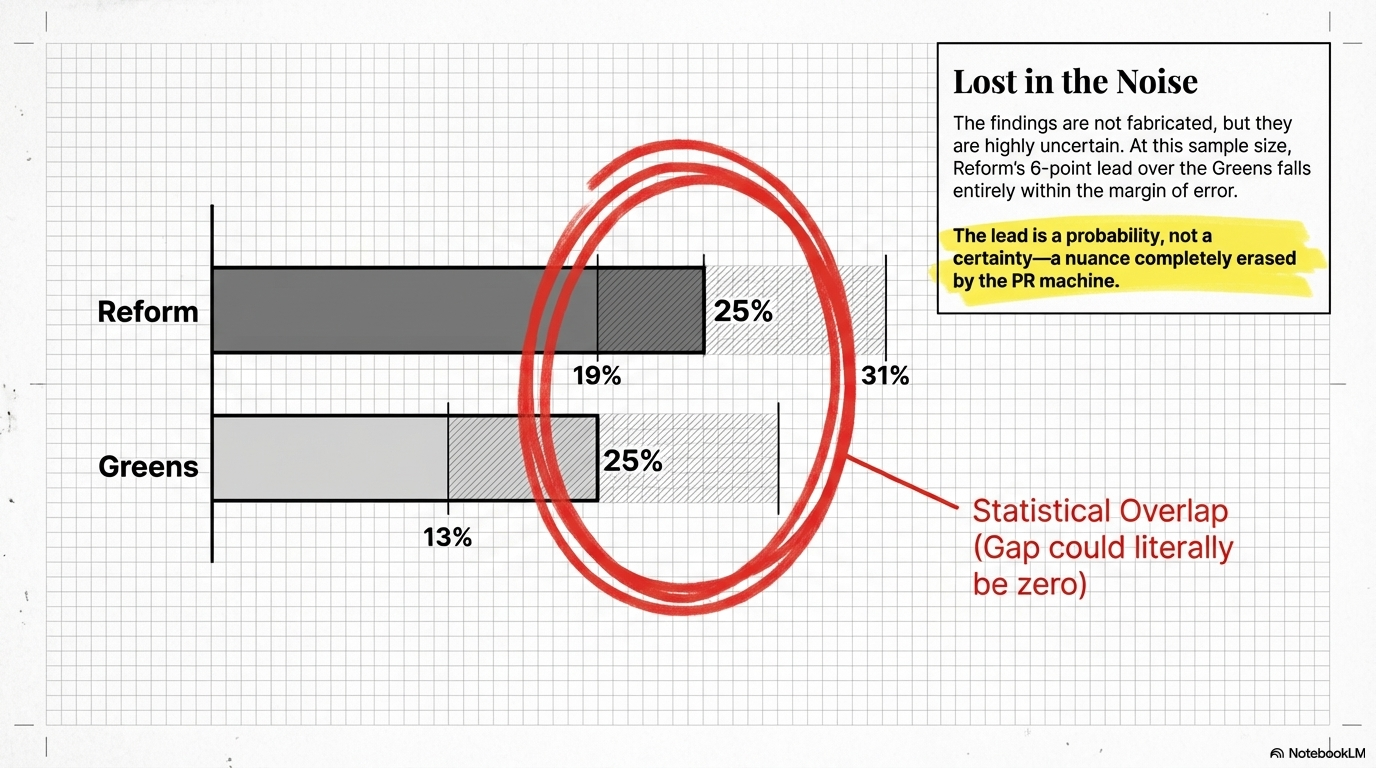
The first and most fundamental problem is the word 'leading.' Reform polled at 25% among gay and bisexual men — placing them six points ahead of the Greens and seven ahead of Labour. That sounds commanding until you do the arithmetic the headline deliberately omits.
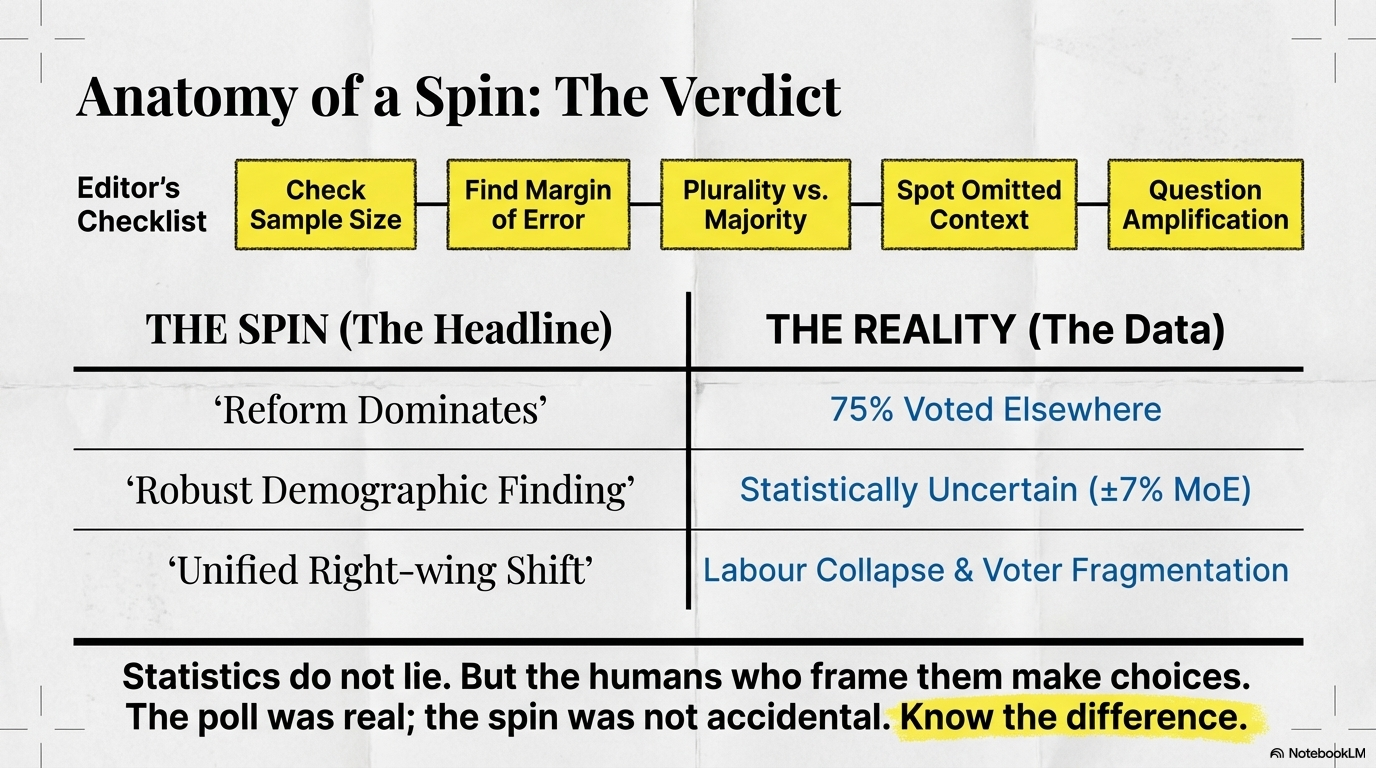
Three in four gay and bisexual men did not intend to vote Reform. In any other political context, a party 'leading' on 25% in a crowded field would be described as fragmented, volatile, or inconclusive. When the Conservatives 'led' the 2010 election with 36% of the vote, they still failed to secure a majority. Yet here, a party on a quarter of a sub-group vote is described as leading with no qualification whatsoever.
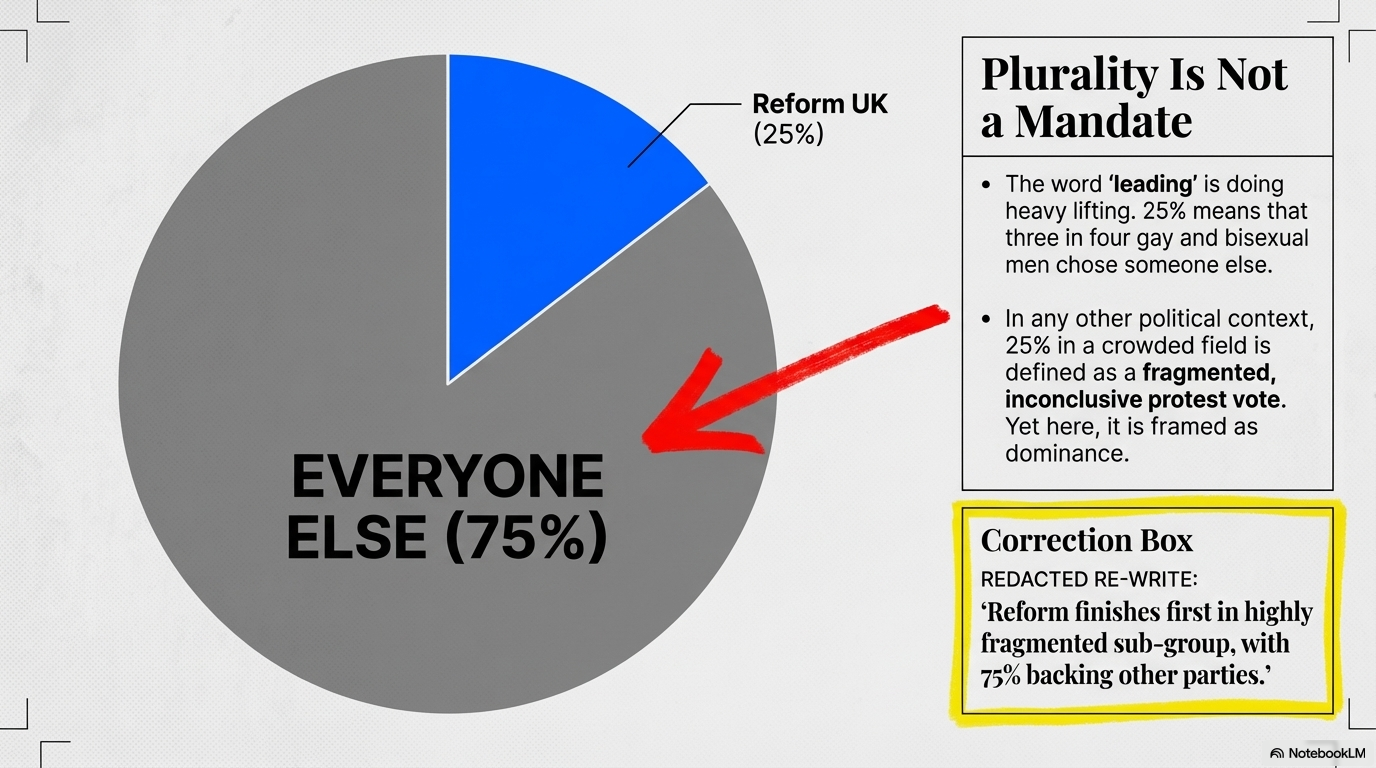
The correct headline — if accuracy were the primary objective — would read: 'Reform finishes first in fragmented gay and bisexual male vote, with three-quarters backing other parties.'
"Leading" with 25% means 75% of gay and bisexual men chose someone else. In what world is that dominance?
2. The Sample Size Problem Nobody Is Talking About
More in Common surveyed almost 9,000 adults across England, Wales and Scotland. That is, by any standard, a substantial poll. But the headline isn't about 9,000 people. It's about a demographic slice within that sample.
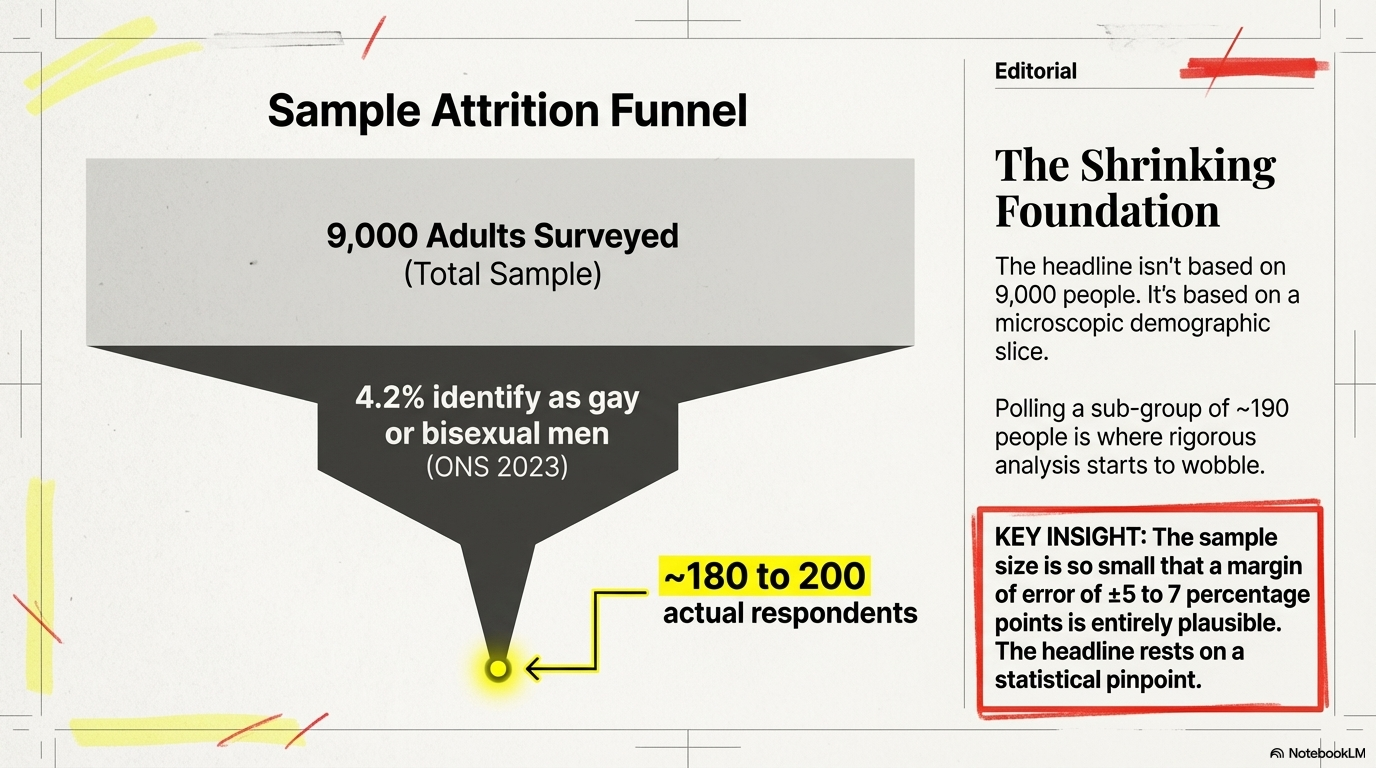
ONS data tells us that roughly 4.2% of men in the UK identified as gay or bisexual in 2023. Apply that to a sample of 9,000 adults (roughly half male), and you are looking at somewhere between 180 and 200 gay and bisexual men. Polling sub-groups at that size is where rigorous analysis starts to wobble. A margin of error of plus or minus five to seven percentage points is entirely plausible.
At a sub-group of ~180-200 respondents, Reform's 6-point lead over the Greens falls entirely within the margin of error. The 'lead' could, statistically, be zero.
This does not mean the findings are fabricated. It means they are uncertain — and that uncertainty should be reported. It wasn't.
3. The Real Story Is Labour's Collapse
Here is what the same poll shows, had anyone chosen to lead with it: 41% of gay and bisexual men voted Labour at the general election in July 2024. Today, Reform leads on 25%. The most dramatic movement in this data is not Reform's rise — it is Labour's catastrophic fall among this group.
Where did those votes go? To the Greens, apparently, and to Reform — suggesting not a unified ideological shift toward the right, but a fragmented protest vote fracturing in multiple directions. Some gay and bisexual men appear to be punishing Labour by moving left. Others by moving right. That is an entirely different — and arguably more important — political story than 'Reform is winning gay voters.'
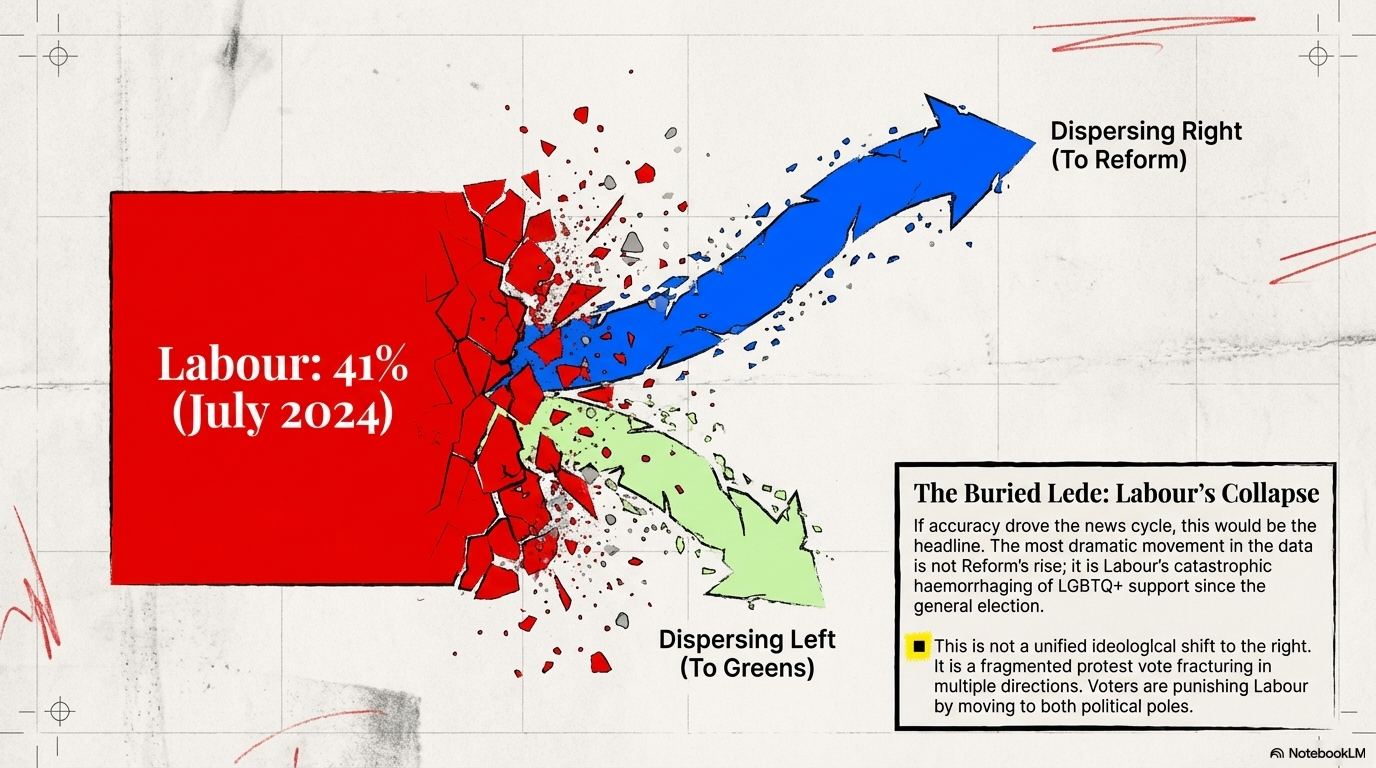
The editorial choice to frame this as a Reform story, rather than a Labour story, is not neutral. It flatters Reform's narrative of growing cross-demographic appeal while burying the more complex and arguably more significant data.
4. Bundling 'Gay and Bisexual' Does Heavy Lifting
The demographic category 'gay and bisexual men' is not a monolith, and treating it as one is statistically sloppy. Gay men and bisexual men are distinct communities with meaningfully different demographic profiles. ONS data shows that bisexual identification has surged particularly among younger people — especially those aged 16 to 24 — who may be responding to entirely different political pressures than older gay men: housing, cost of living, student debt.
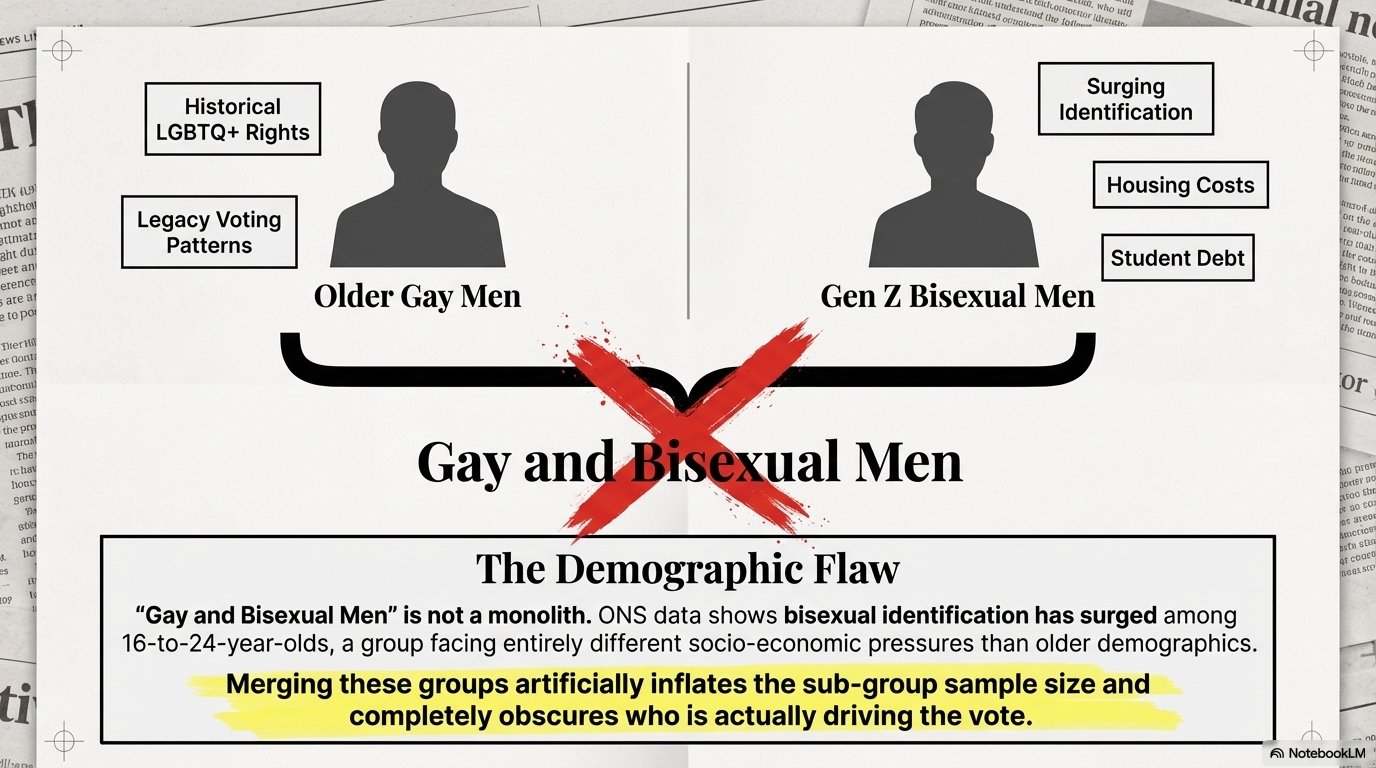
By merging the two groups, the poll conveniently achieves two things. First, it inflates the sample size — creating the appearance of a more robust finding than exists for either sub-group separately. Second, it obscures whether Reform's apparent support is concentrated among one community or distributed across both. We simply cannot tell. And we should be told.
5. The Amplification Was Not Organic
The chart was shared prominently on social media by Reform figures including Darren Grimes and Dr David Bull. This is worth noting not to suggest the polling firm acted improperly — More in Common is a reputable organisation — but to understand how data moves in the political media ecosystem.
A party's communications operation shares a poll that flatters them. Friendly outlets report on the social media attention the chart is getting, treating the amplification itself as newsworthiness. The story becomes self-fulfilling: Reform sharing the data becomes evidence that the data matters. This is a well-worn PR technique, and it works.
The original research was also carried out at the end of 2024 but published in early 2026 — a timing that maximises news cycle impact without the scrutiny that would accompany a formally commissioned pre-election poll.
6. The Context Nobody Led With
Any honest piece of journalism about Reform's standing with LGBTQ+ voters should carry the following context, not buried in paragraph eleven, but near the top where readers will actually encounter it.
Reform's last manifesto vowed to overhaul the Equality Act and ban what it termed 'transgender ideology' in primary and secondary schools. Following last year's local elections, the party announced that the ten councils it controls would be banned from flying the Pride flag. Farage has stated he did not support same-sex marriage, claimed in 2019 that people living with HIV should not be allowed to enter the UK, and described Section 28 — the law that for years prevented schools from discussing same-sex relationships — as a response to 'very, very extreme left-wing elements within the teaching union.'
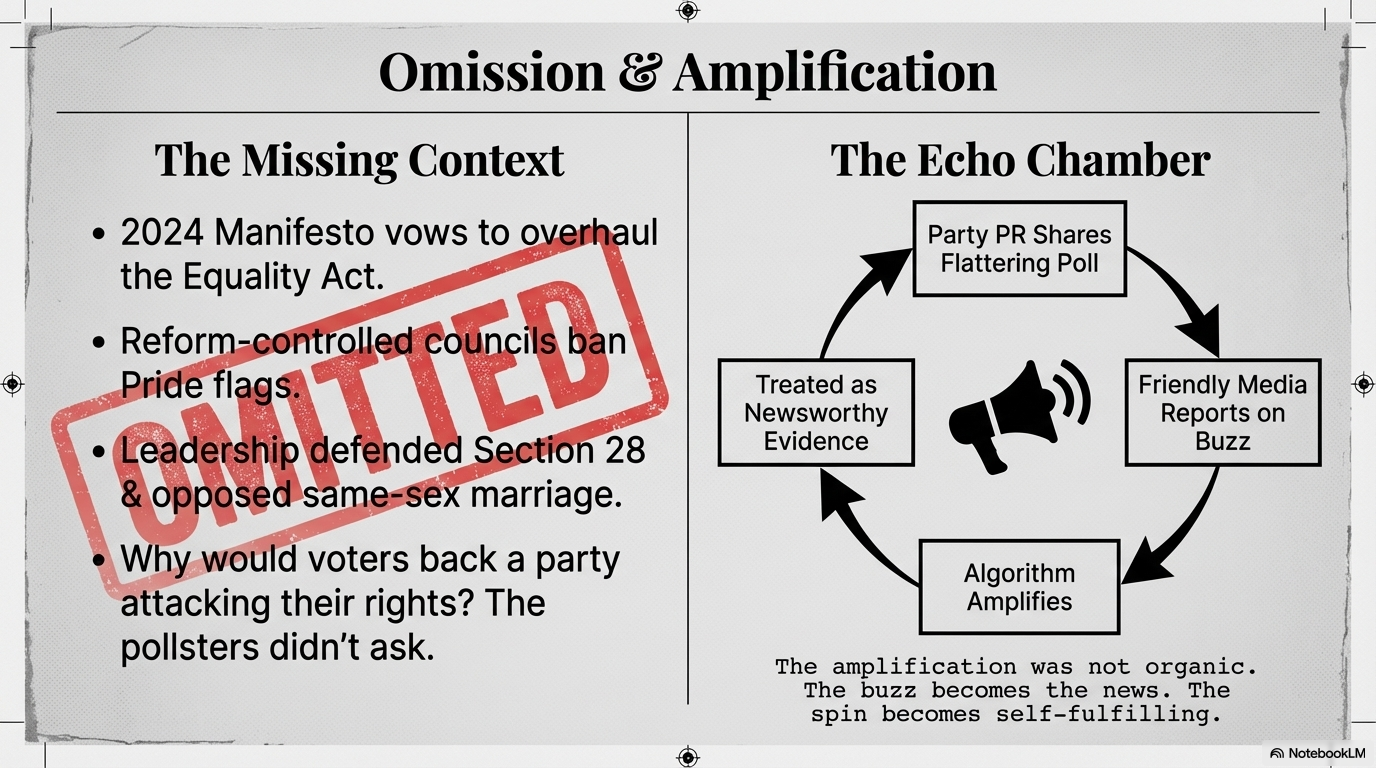
This is not editorialising. It is the public record. A 25% vote share among a community whose legal protections a party actively threatens is not a triumph to be celebrated uncritically. It is a finding that demands interrogation: why, and in what circumstances, would voters support a party working against their interests? That is a fascinating question. Nobody appears to have asked it.
So What Does the Poll Actually Tell Us?
Here is a fair summary of what More in Common's research genuinely shows, with appropriate caveats applied.
Among a sub-group of gay and bisexual men — likely around 180 to 200 respondents, with corresponding margins of error — Reform polled first on around 25%, in a heavily fragmented field. Labour's vote share among this group has collapsed dramatically since the July 2024 election, with votes dispersing both leftward to the Greens and rightward to Reform. The gap between Reform and the Greens is small enough to be within statistical noise. The headline finding may not be reproducible in a larger sample.
That is an interesting data point worth reporting. It suggests Labour has a serious problem retaining LGBTQ+ voters — and that political allegiance in this community is more volatile and less predictable than many assumed. It raises important questions about what is driving disillusionment.
What it does not show is that Reform is the party of choice for gay and bisexual men, that the community has turned toward a party that opposes many of their rights, or that Reform's cross-demographic appeal has been demonstrated. Those are the stories that were told. They are not the stories the data supports.
The numbers are real. The story constructed with them is something else entirely.
Statistics do not lie. But the humans who select which statistics to report, how to frame them, what context to include or omit, and which headline to write — they make choices. And sometimes those choices, individually defensible, collectively add up to something misleading.
The next time you see a poll claiming a surprising finding about a minority community, ask yourself: what is the sub-group sample size? What does the full distribution look like, not just who came first? What changed, and for whom? Who is sharing this, and why? What context is missing?
The poll was real. The spin was not accidental. And now you know the difference.
Source: More in Common polling, published 2026. ONS data on sexual identity, 2023. Reform UK 2024 general election manifesto.
Support independent LGBTQ+ journalism
Scene was founded in Brighton in 1993, at a time when news stories about Pride protests were considered radical. Since then, Scene has remained proudly independent, building a platform for queer voices. Every subscription helps us to report on the stories that matter to LGBTQ+ people across the UK and beyond.
Your support funds our journalists and contributes to Pride Community Foundation’s grant-making and policy work.
Subscribe today


Comments ()