

A Queer Carol {ii}: The Ghost of Christmas Past
The first spirit arrives, ethereal and decidedly non-binary in their Victorian nightgown situation, to escort our protagonist through memory's labyrinth.
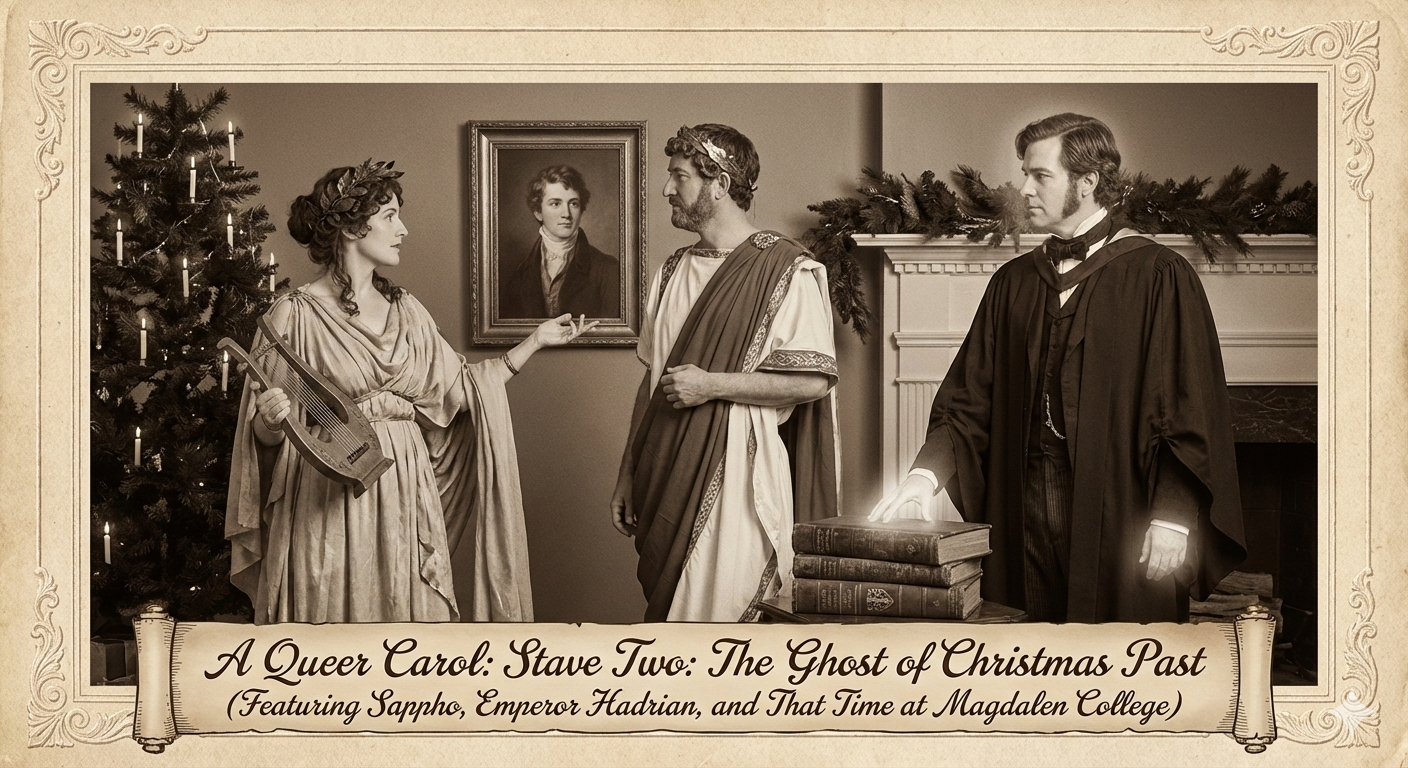
(Featuring Sappho, Emperor Hadrian, and That Oscar Wilde)
Read part one here:
The first crepuscula spirit arrives, ethereal and decidedly non-binary in their Victorian nightgown situation, to escort our protagonist through memory's labyrinth.
After a suitably ironic flashback supercut we drift back to ancient Lesbos, where Sappho reclined during winter festivals, composing verses about a certain female companion while the solstice fires blazed. "Come back to me, Gongyla," she wrote, words that survived two millennia of determined erasure. History, that revisionist houseguest, tried calling them "passionate friendships" for centuries—much like they did with Eleanor Butler and Sarah Ponsonby, the Ladies of Llangollen, who in the 1770s scandalized society by running away together (twice!) and then gasp living together in romantic seclusion, celebrating their own private Christmases far from hetero-regulative expectations.
The spirit whisks us to Hadrian's Rome during Saturnalia, where the Emperor mourns his beloved Antinous. When the beautiful youth drowned in the Nile, Hadrian didn't merely grieve—he deified him, founded cities in his name, commissioned countless statues. This wasn't subtext, sweethearts; this was text in 72-point Trajan font. During the winter festivals, priests of the new Antinous cult performed rites - centered on Hadrian's grief and love - that made the Senate deeply uncomfortable.
Forward through time we flutter, we pause to pay our respects at a huge Viking warrior funeral in Birka, admiring the lavishly brutish items being laid alongside and belonging to an incredible warrior, which in the view of 19th century gender norms could definitely only be somebody male, but who's bones spoke a different truth and was born female, offering us insights into gender queer warriors of the dark times, we fade onwards in time to medieval monasteries where "particular friendships" bloomed during the dark nights of Advent. To Renaissance Florence, where Michelangelo spent Christmas 1532 probably thinking about Tommaso dei Cavalieri while pretending to pray. To Shakespearean England, where nobody questioned why all those cute actors playing Rosalind and Viola were young men in dresses, the theatre has always been our natural habitat.
We pause at Oscar Wilde's Christmas of 1892, before his downfall, when he gave Lord Alfred Douglas extravagant gifts and society tut-tutted but hadn't yet destroyed him. Three years later, he'd be in Reading Gaol, writing "De Profundis" while other prisoners sang carols.
"See," whispers the Spirit, "how every age has its Scrooges and its Fezziwigs—those who hoard their truth and those who celebrate it?"
Read part three tomorrow
Support independent LGBTQ+ journalism
Scene was founded in Brighton in 1993, at a time when news stories about Pride protests were considered radical. Since then, Scene has remained proudly independent, building a platform for queer voices. Every subscription helps us to report on the stories that matter to LGBTQ+ people across the UK and beyond.
Your support funds our journalists and contributes to Pride Community Foundation’s grant-making and policy work.
Subscribe today
Comments ()